
Chew It In Reverse
Serena Chang’s Means of Production
Annette An-Jen Liu | April 17th, 2026
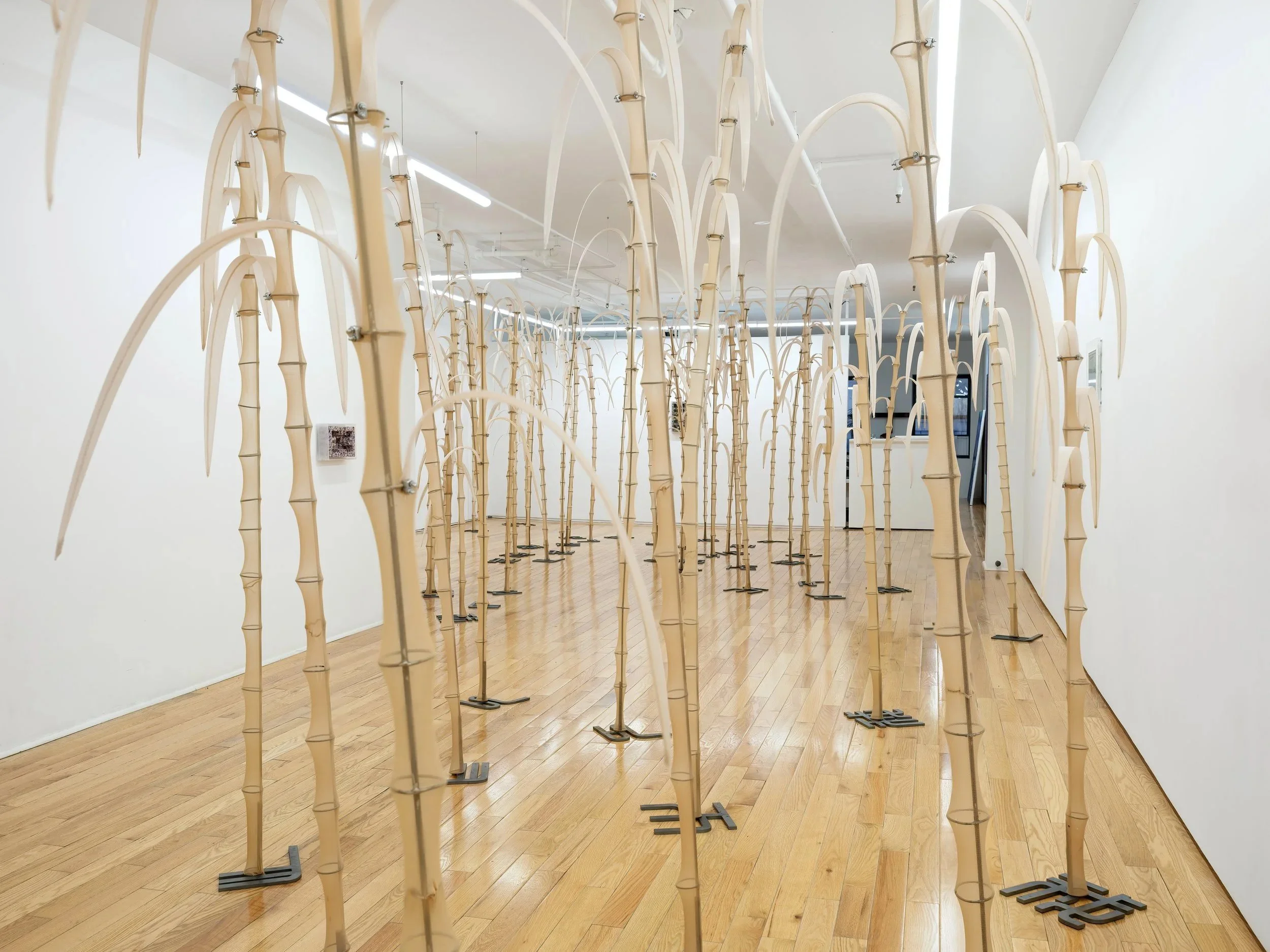
Serena Chang, Sweet Water, 2024. Dimensions variable (60 stalks). Hoisery, steel, PETG plastic. Sweet Water, island gallery, 2025. Image courtesy of island gallery.
The Art Critic Fellowship is an art writing intensive program launched in 2025. Now in its second year, fellows engaged in three lectures led by award-winning editors and writers to discuss the joys and concerns of writing and editing art criticism today, and met one-on-one with their assigned mentors to develop a piece of criticism for publication on AICA-USA’s Magazine.
The Art Critic Fellowship is supported in part by the National Endowment for the Arts.

Annette An-Jen Liu is part of the 2026 cohort and was paired with Sharon Mizota as her mentor.
I came to know of sugarcane anecdotally. There’s a sugarcane juice stall at the neighborhood night market my mom would always stop by in Taipei. With each order, the stalks would be cut, charred, and crushed to squeeze out their golden nectar. It tasted divine. In my seventh-grade class, a Mandarin teacher quizzed us on the second half of an idiom that described the consumption of the crop. The expression goes, “eat the sugarcane from the top down, and one enters into fairer grounds.” [1] Conveying the idea that situations improve as they progress, the saying is based on the understanding that the sucrose in sugarcane is concentrated in its stalk, toward the bottom, so one ought to savor and chew it in “reverse.” A classmate had responded, “-and the juices become sweeter,” to which everyone erupted with laughter—it wasn’t accurate, but it was correct.
While I only saw sugarcane fields in passing when I traveled south, I grew up learning that it was central to Taiwan’s early economic history. It became a cash crop throughout the island nation’s various colonial periods: the Dutch cultivated it into plantations, and the Japanese set up industrial refineries for international export.[2] Emerging from a 38-year period of martial law following the Chinese Civil War, Taiwan’s economy developed rapidly in the latter half of the 20th century: from agriculture to labor-intensive manufactures like textiles, to one of high-income industrialization and high technology, the country’s exponential progress is often described as the “Taiwan Miracle” [3]—as the sugarcane saying goes, circumstances improved as they progressed.
Traces of this economic trajectory, from rural sugarcane cultivation to urban textile manufacturing can be found in the Taiwanese American diaspora, and New York-based artist Serena Chang’s practice uniquely illuminates this history. Chang’s father migrated during Taiwan’s golden era of textiles in the 1970s and 1980s, when hosiery was largely produced and imported to the United States. He worked for Marathon Hosiery, a company in Red Hook, Brooklyn, until the early 1990s, before founding his own company, Sheerly Touch-Ya, in 1992. When Marathon’s owner retired, he absorbed the stock into his new business and maintained most of the production in Taiwan. Sheerly Touch-Ya, originally named Serena, eventually became a transnational inheritance of his daughter’s.
This rich biographical context acutely informs Chang’s practice and weaves poetically throughout her interdisciplinary work. In Sweet Water, Chang’s debut solo exhibition in 2025 at island gallery, she explored the legacy of her family’s hosiery business through an installation repurposing stocking materials and packaging molds. The titular work consisted of 60 skeletal sugarcane stalks made from nude hosiery dispersed across the gallery, forming a suspenseful “ghost forest.” These towering structures were assembled with visible hardware that the textile stretched across to create distinct plant nodes and leaves, rendering the sugarcane crop legible. The semi-sheer fabric and segmented design also evoked elegant limbs, nodding to its material source while conjuring apparitional form, poised in distant memory. The steel base of each stalk is a fragment of Traditional Chinese characters “you” (你), “me,” (我) and “us” (我們), grounding the work in both the personal and collective.
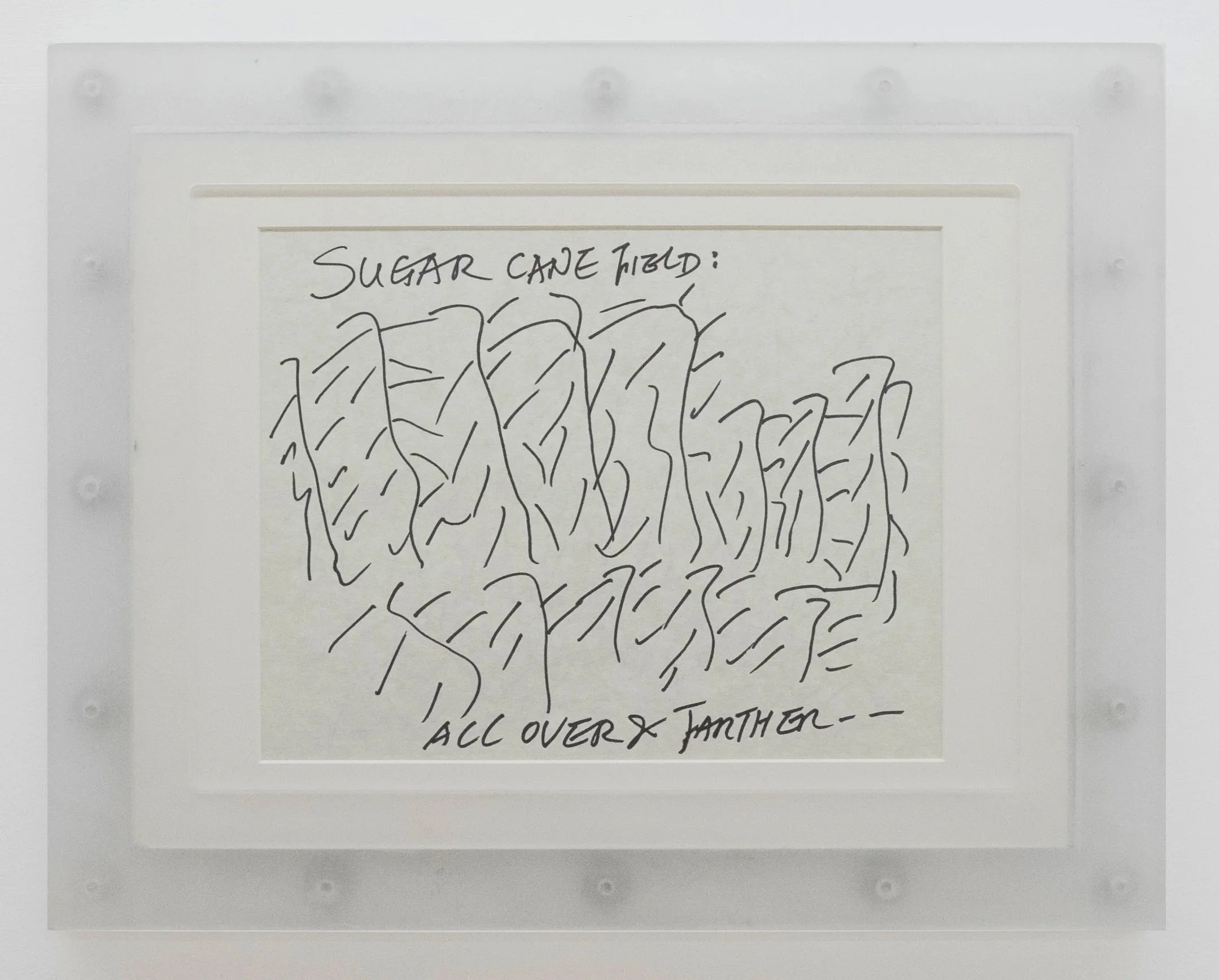
Serena Chang, Sugar Cane Field, All Over & Farther, 2024. 15.5 x 12.5 x 0.75 inches, acrylic, aluminum, paper, ink. Sweet Water, island gallery, 2025. Image courtesy of island gallery.
A rough sketch by Chang’s father of a sugarcane field he grew up around is displayed on the wall between two hosiery stalks, revealing the installation’s interpretation of a nostalgic countryside. The drawing is annotated: “SUGARCANE FIELDS: ALL OVER & FARTHER"—there are few photographs of this exact field that no longer exists. However, the legacy of abundant sugarcane farming in southern Taiwan where Chang’s family is from, is said to have sweetened the local cuisine to this day, and even the water. Sweet Water presents a striking interpretation of the artist’s lineage, as it gestures toward Taiwan’s agricultural past before the country largely transitioned to textile manufacturing, while pointing to broader themes of evolving industrial landscapes, inherited immigrant and collective labor, and personhood.
A series of wall pieces (2020-2024), each “Untitled” with a unique serial number, showcase dense image collages on packaging molds from Sheerly Touch-Ya.Manufactured for storage and shipping, these molds are shaped to the contours of a product to secure it within its packaging. Each work consists of a kaleidoscopic pattern made from Sheerly Touch-Ya’s packaging graphics—cropped photos of legs and torsos modeling hosiery. The images, made in collaboration between Chang’s father and the Taiwanese hosiery factories in the 90s, are abstracted in their multitude and layering, forming textures that enhance the symmetrical, ridged molds and its structural ribs. The body is evoked here in the negative space, highlighting the meticulous handwork in both the collage and the preparatory materials for textile distribution—a reminder of the embodied labor in both art and economic production.
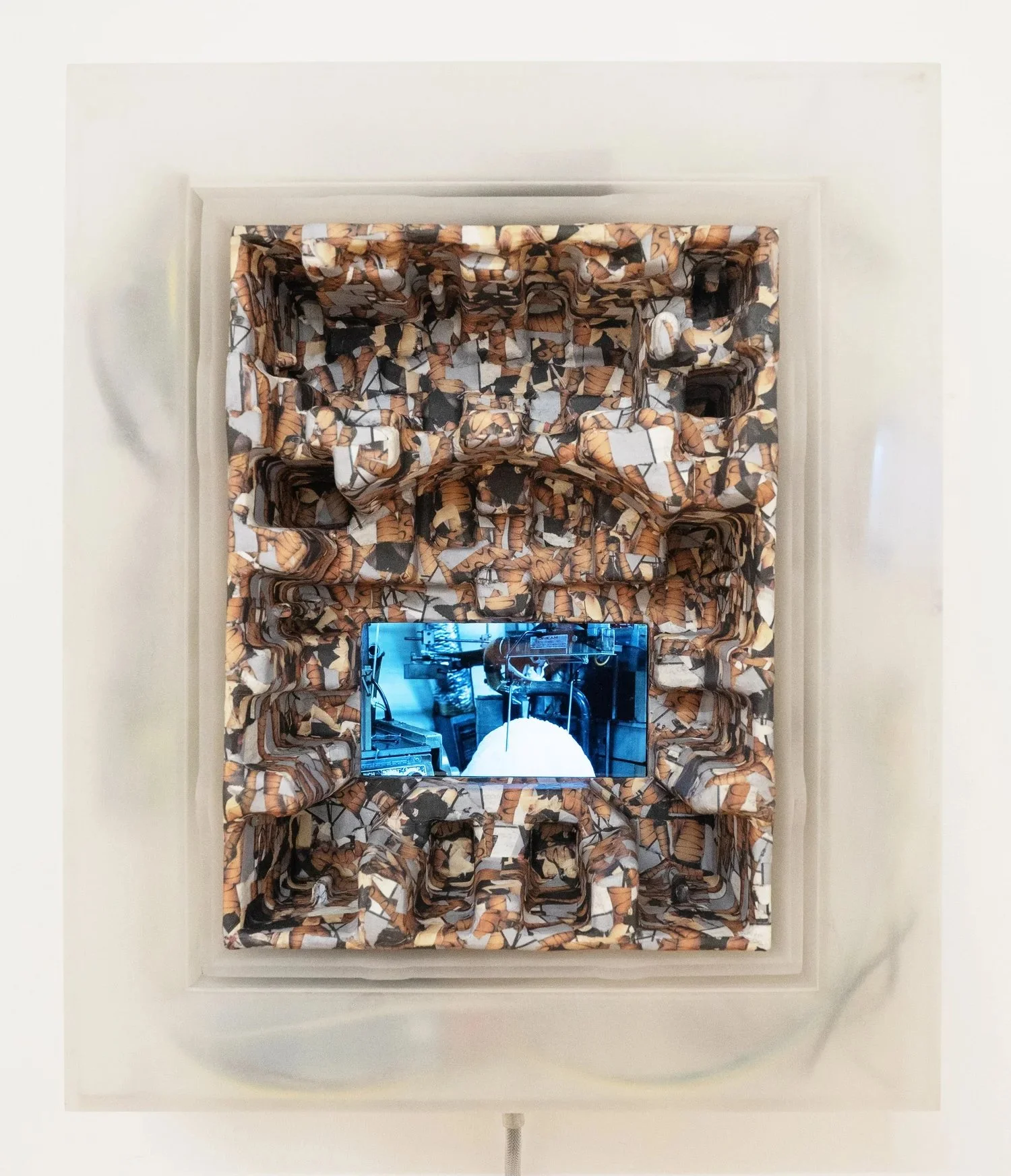
Serena Chang, Conduit for Dreamt Waters, 2024. 16 x 19 x 7.5 inches, wood, paper, pigment, PVA adhesive, acrylic, clear coat,power supply, speakers, amplifier, monitor, media player. Sweet Water, island gallery, 2025. Image courtesy of island gallery.
Chang’s evolving practice continues to explore the visual history of the family business. Recent iterations of the “Untitled” series frame small monitors, such as “Conduit for Dreamt Waters” (2024), where a video montage of footage from the hosiery factory in Taiwan is overlaid with other landscape drawings and annotations by Chang’s father of his childhood. Ambient noise of mechanical whirs and wildlife sounds color the video’s contrasting environments, creating an intimate portrayal of the family journey. The video work foregrounds Chang’s position within this transnationalheritage and flow of capital. Through her editing, she appears as a keen observer of the personal histories and processes underpinning hosiery as a global commodity in local production.
“Inventory” (2025), a new work that debuted this January at the group show Endless Garment: Atlantic Basin [4], responds to this dichotomized relationship most concretely. Displayed on the stairwell leading up to the exhibition, the subtle work features three identical photographic prints of a cardboard surface with handwritten import/export text of “NEW YORK” and “MADE IN TAIWAN.” Reproduced at a 1:1 scale and framed in steel, the images allude to the international movement of cargo in industrial containers and the warehouse storage of bulk products. The cardboard’s text was handwritten by Chang’s father for a makeshift box, showcasing the artist’s ongoing, intergenerational and attentive collaboration with her family. This engagement sharply contrasts the current, volatile socio-economic climate, marked by trade wars where outsourcing and importing strategies are continuously reassessed. As a photographic work, “Inventory” teases an image of a vast global network—one that, like the loosely adhered print, warps under pressure.
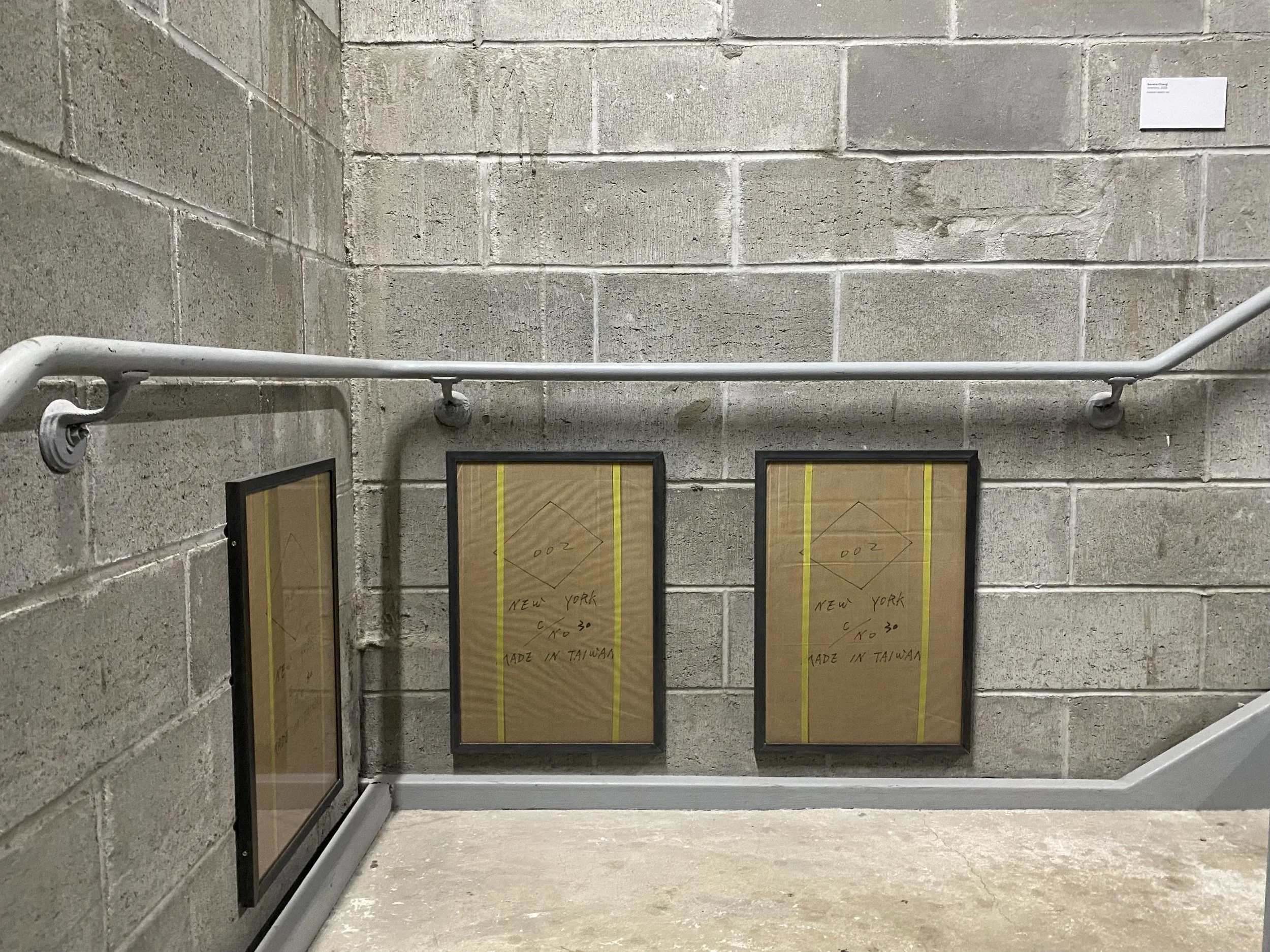
Serena Chang, Inventory, 2025. Ink on paper, 16 x 23 inches. Endless Garment: Atlantic Basin, Pioneer Works, 2026. Photo: Annette An-Jen Liu.
I first met Serena in 2024, at the Sheerly Touch-Ya warehouse in Queens, when she organized Means of Production, a sprawling group exhibition of over 75 artists. Co-curated with Lily Jue Sheng and Do Tuong Linh under their artist collective Lunch Hour (est. 2023), the independent project accepted every application from an open call about artworks that explored the “mythologies around authorship, work, and labor.” It was an ambitious undertaking that brought together paintings, sculpture, photography, performance, and more, and situated artworks throughout the large industrial space, amongst storage racks and atop stacked boxes. The self-organized exhibition marked the first time the warehouse was open to the public, contextualizing Sheerly Touch-Ya directly in relation to contemporary artmaking and production.
The show also revealed that the warehouse contained SHISANWU, an art fabrication company and material research facility Serena co-founded in 2018, as well as artist studios. While I was struck by the biennial-scale activation of this remote site, I was more intrigued by the interpersonal layers of the project, and the way it framed conversations about wage labor in the artist economy, prompting visions of new sustainable models for working in community. It was invigorating. Looking back, Means of Production was a perfect introduction into Serena’s practice: the socially engaged topics that ground her as an artist, and the public-facing, community-oriented aspects of her supporting role as a fabricator, curator, facilitator, and co-founder. This blurred multi-hyphenate positioning is common among those of us working in the arts, under a capitalist landscape that doesn’t prioritize sustained, nuanced collaborations. In her delicate balancing of personal narratives with intergenerational histories and economic networks, Serena demonstrates how this lateral way of working toward a shared future is both possible, fruitful, necessary, and even sweet.
倒吃甘蔗,漸入佳境 – The first part of the expression literally translates to “eat the sugarcane in reverse,” as opposed to the usual consumption of chewing sugarcane from the root up.
Wang Dayuan (1311–1350) first recorded sugarcane in Taiwan in his 1349 travelogue Dao Yi Zhi Lue (A Brief Account of Island Barbarians), describing how Indigenous people fermented it into wine. The crop later became central to Taiwan’s colonial economies under the Dutch (1624–1662) and the Japanese (1895–1945). After the Chinese Civil War, Chiang Kai-shek retreated to Taiwan in 1949, and martial law remained in effect until 1987.
“Inside the Taiwan Miracle,” Institute of Economics, Academia Sinica, accessed March 13, 2026, https://www.econ.sinica.edu.tw/18/archives/46eaa3b1770e8762 ; John Ruwitch, “Taiwan’s ‘Silicon Shield’: How Semiconductors Shape Its Security,” NPR, October 7, 2022, https://www.npr.org/2022/10/07/1127595393/taiwan-miracle-semiconductor-silicon-shield-china”
Curated by Jeppe Ugelvig, Endless Garment: Atlantic Basin is a group exhibition featuring works by Serena Chang, Chang Yuchen, CFGNY, Huang Po-Chih, and Shanzhai Lyric exploring the “ways in which Asian fashion production is represented.” The show is on view through April 12, 2026, at Pioneer Works in Brooklyn, New York. I wrote a review about the exhibition for the Brooklyn Rail’s March issue.
Annette An-Jen Liu is a Taiwanese arts writer and early-career curator based in New York. Liu’s writings have appeared in ArtAsiaPacific, Art Monthly Australasia, Art Basel Stories, The Brooklyn Rail, Magnum Photos, MOLD Magazine, among other places. She has authored cover features in Mandarin for the award-winning Taiwanese magazine Voices of Photography and curatorial essays for exhibitions at PhotoAccess in Canberra. Liu has contributed research to the exhibition catalog, Wolfgang Tillmans: To look without fear (Museum of Modern Art, New York, 2022), and translated essays for the artist Cai Guo-Qiang. She served as Guest Editor for two issues of 4N Magazine, and was a 2020 Critic-in-Residence with Art Monthly Australasia. Liu received an M.A. in Curatorial Studies from the University of Sydney and holds a double Bachelors from the Australian National University, majoring in Photography and Anthropology. In 2023, she received an Andy Warhol Foundation Arts Writer Grant in Short-Form Writing.