
They are each other’s happiness
Patric McCoy at MCA Chicago
Derrick Austin | April 17th, 2026
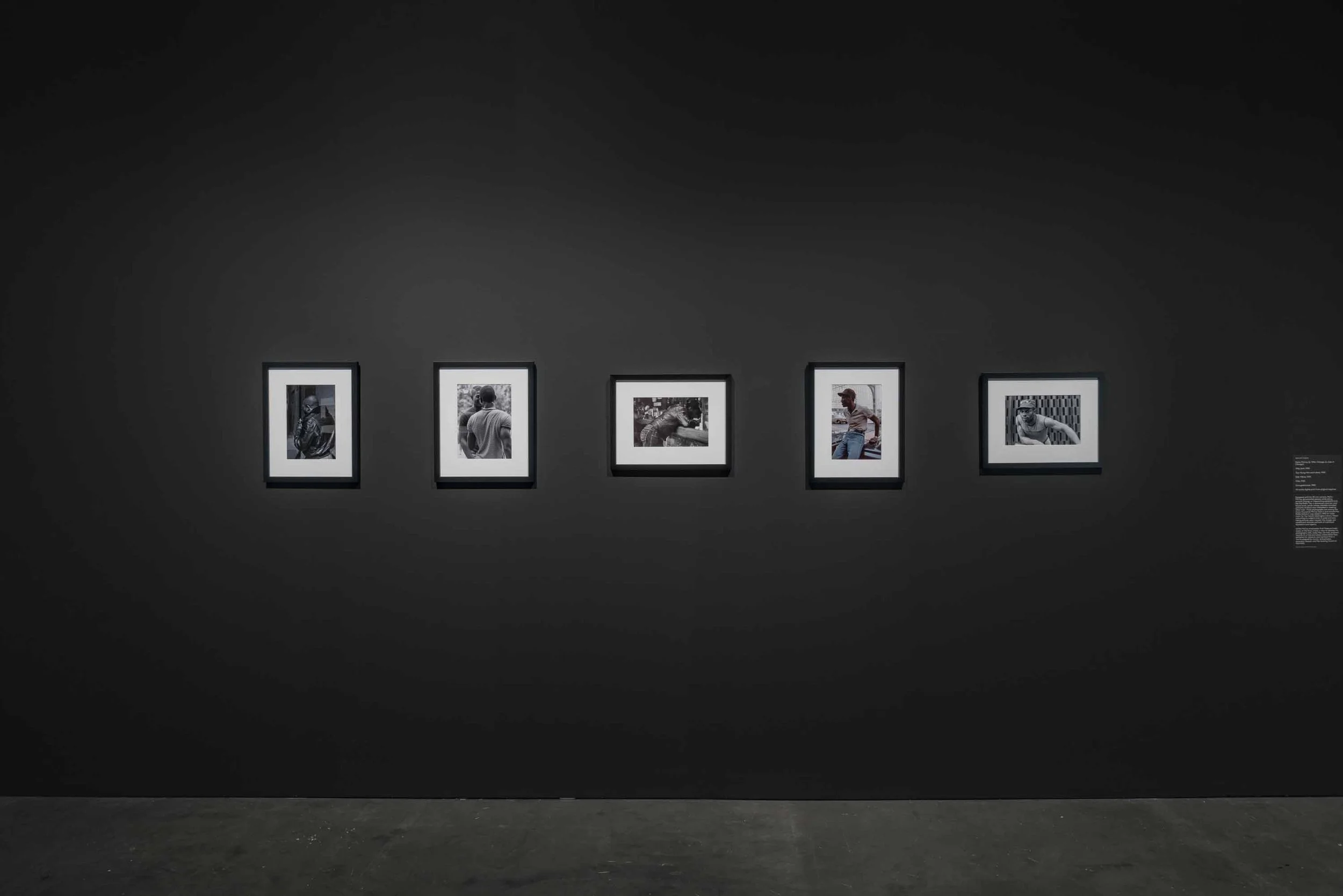
Installation view, City in a Garden: Queer Art and Activism in Chicago, MCA Chicago. July 5, 2025 – May 31, 2026. Photo: Robert Chase Heishman.
City in a Garden: Queer Art and Activism in Chicago
Museum of Contemporary Art Chicago
Chicago, IL
July 5, 2025 – August 16, 2026
The Art Critic Fellowship is an art writing intensive program launched in 2025. Now in its second year, fellows engaged in three lectures led by award-winning editors and writers to discuss the joys and concerns of writing and editing art criticism today, and met one-on-one with their assigned mentors to develop a piece of criticism for publication on AICA-USA’s Magazine.
The Art Critic Fellowship is supported in part by the National Endowment for the Arts.

Derrick Austin is part of the 2026 cohort and was paired with Daria Simone Harper as his mentor.
1.
You could find anything at the Rialto. Joints, lottery tickets, liquor, Mr. Right Now. It wasn’t classy, but everyone had a good time. Open through the 80s in Chicago’s South Loop, the Rialto wasn’t acknowledged as a Black gay bar by its owner, but people knew what was up. Men from as far as Japan got their life in that smoke-filled dive, which was listed as a hot spot in international gay travel guides. In the Illinois prison system, men were told to stop by the Rialto. Professors danced with men down on their luck. Regulars wandered in from Pacific Gardens, a nearby homeless shelter, and nursed a beer beside activists, local celebrities, bankers, and students. They were the same in their pleasure. They were the same when cops raided, too.
2.
In Patric McCoy’s Alley Joint, a black-and-white photograph, I can’t see the face of the man lighting up outside the Rialto. Concentrated on his task, he’s nearly turned away. America’s history of racism and surveillance complicates the idea of privacy for Black citizens, particularly in public spaces, yet this photo preserves his anonymity without feeling remote. The tight composition, focused on a moment of respite, enhances its intimate atmosphere. Its suggestive spareness activates other senses: imagine the funk of a city at night, muffled house music. Alley Joint is a study in blackness. Its textures and varieties. Black alley. Black man in a black jacket. Brick. Flesh. Leather. The grain of his close cropped hair. The fur collar, this warm softness at his neck. The picture builds anticipation. He’s waiting for the light. Spark. Heat.
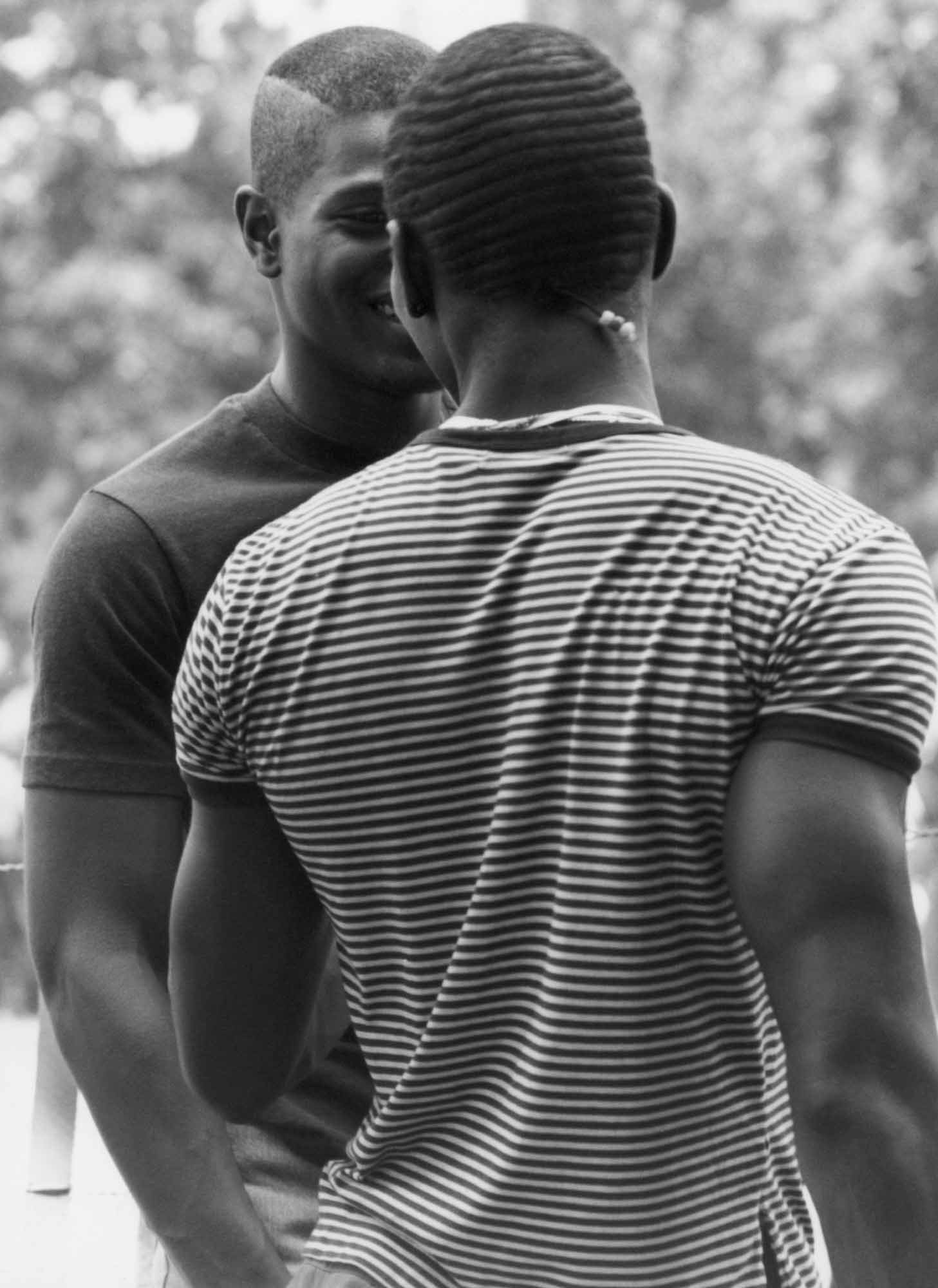
Patric McCoy, Two Young Men and Waves, 1985. Digital print from original negative. Courtesy of the artist, Chicago.
3.
Other men hustling photographs around the Rialto regarded McCoy with some chagrin since he didn’t charge. A self-taught artist, he promised himself that he would photograph anyone who asked so he could practice using his 35-mm camera. On his commute from South Shore to his job in the South Loop, biking through neighborhoods loud with children’s laughter or leveled by Ronald Reagan’s destructive economic policies, people flagged him down. He became a local fixture through word of mouth. Why would you ask somebody to take a picture you’re not expecting to get, he asked himself in a 2023 interview [1], still surprised by his subjects’ generosity. When someone focuses their attention on you, especially if you’ve felt ignored or belittled, the delight of recognition can prove irresistible like love, and I imagine, in a time before cameraphones, a photographer’s gaze must have been intoxicating. McCoy never posed his subjects, so they chose how they were seen. Perhaps because of gendered expectations of self-presentation, mostly men requested pictures. It was also a chance to strike up a conversation. Or flirt.
4.
A man leans against the bar in this photograph. I cock my head because his ass is nice in tight jeans. My eye begins at that worn back pocket, the lower end of a strong diagonal bisecting this horizontal image, which begins at the slope of his ass and ends at his head obscured by shadows and a hat. At first I wondered: Has he worked up the courage to hand his number to the seated man whose arm is visible? But this is Dear Mama. The title entreats us to finish the letter and identify with, or at least recognize, a Black man’s inner life as he jots down memories, secrets, fictions, or requests. His hidden, private face forces us to attend to what’s behind it: a buzzing mind.
5.
The city had changed drastically by 1985 when McCoy took these photos featured in the Museum of Contemporary Art Chicago’s exhibit City in a Garden: Queer Art and Activism in Chicago. White flight opened space in the Loop for Black business and pleasure. Peep shows operated near movie theaters screening kung fu films. The economic downturn changed the majority populations of homeless shelters from old white men to young Black men. As housing projects shifted from supporting families to mothers with children, drifting fathers communed at places like the Rialto. DJs would spin the newest house music for patrons, plenty of whom were open about their sexual preferences, but many wouldn’t have identified as gay or same-gender loving as it was called at the time. Stigma around homosexuality acted as a deterrent, but there was also less of an emphasis on identity as fixed. An erotic porousness distinguished that world. This too, I believe, was connected to a strong sense of communal identity, we rather than I. We’re in it together, in our pleasure and pain.
6.
I make a beeline for the man with veins running along his biceps, Playboy emblazoned over his heart. His arms are flexed as he leans forward as if expecting me to speak. I would dissolve before him and stumble over my words. His gaze reminds me of the barmaid in Manet’s A Bar at the Folies-Bergère. What I love about Manet’s painting of worktime malaise is how the background’s visual density—the great mirror reflecting a packed, rowdy bar with a chandelier and trapeze artist floating overhead as well as the barmaid’s impossible reflection—colors her expectant, slightly opaque, gaze. Behind McCoy’s playboy is a wall of corrugated steel, which are all eyes. The two buttons on his cap are eyes. His eyes press me. I’m pleased by his firmness. Depending on the viewer, his directness could allure or rebuke. Given how Corrugated Look makes dichotomies of flesh and steel, openness and hardness, perhaps he is loath to engage with us.
7.
Dick is beautiful. Dick will drive you crazy. His name, like the title of this photo, is Mike not Dick though his belt buckle says otherwise. (McCoy has a poet’s eye for wordplay.) Mike ran with a set who hung around the Rialto but never went inside. Perhaps, the wedding ring on his hand was too weighty to hide. Mike’s attention is elsewhere. He leans against the hood of a parked car, body tense with potential. Behind him, a support beam for the El train arcs forward, echoing the position of his upper body. The only color photo in this suite lacks an easy brightness. It’s freighted by restlessness and tension. His body and the beam form two strong verticals while the parked cars on either side of the street behind him form a horizontal line that intersects with the building dominating the background, which was demolished along with the Rialto to make way for the Harold Washington Library.
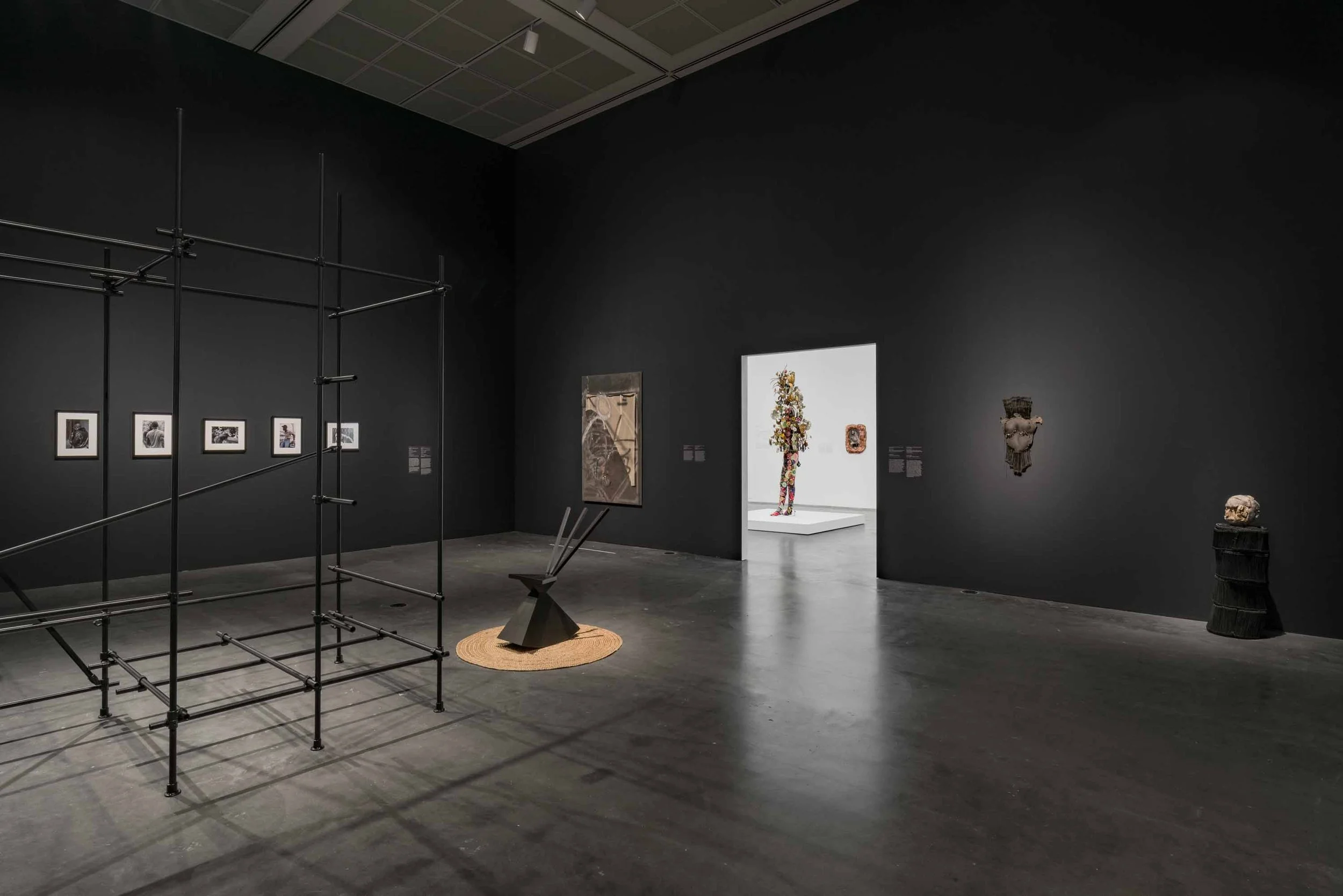
Installation view, City in a Garden: Queer Art and Activism in Chicago, MCA Chicago. July 5, 2025 – May 31, 2026. Photo: Robert Chase Heishman.
8.
McCoy stopped taking pictures shortly after the Rialto shuttered in 1989. His photographs are often spoken of as monuments to a lost world devastated by racism and the AIDS crisis, but monuments are tricky. Monuments are periods at the end of a sentence. They say: This happened but it’s over. History is never past and certainly not history from less than fifty years ago. Wrightwood 659, which organized an exhibit of McCoy’s photographs in 2023, held a talk moderated by the artist called Men of a Certain Age [2] in which elders who frequented the Rialto and other Black queer bars in Chicago’s southside, reunited for an hour and a half of laughter and reminiscence. Watching a recording, I took notes and tried to excerpt stories too large for this essay. The names of a dozen more Black gay bars. A man receiving another’s number on the back of his neck tie. Reflecting on these photographs and the context out of which they emerged, I feel the profound loss of a vastly more social and sociable world. It’s difficult to imagine a McCoy emerging now that images can be instantaneously taken, transmitted, and manipulated. A stranger shooting footage in public carries a different charge in 2026. Besides, would anyone strike up a conversation with a stranger? We live in pinched and narrow times.
9.
I don’t turn to art for consolation during a crisis. I don’t have the energy to give art my full attention, let alone receive it as a salve. Looking at pictures does, however, relieve my loneliness, and I have spent much of my peripatetic adulthood alone, moving to the next opportunity in order to make ends meet. Isolation is the spirit of the age. It’s banal to say Americans feel profoundly disconnected from each other, exacerbated by the loss of communal spaces, by years of upheaval and unreckoned-with-grief, and yet it’s astonishingly easy, depending on where one lives, to commute, shop, and work while never having more than a brief exchange of words with another person in this historical moment organized around ruthless efficiency. I don’t romanticize the past. I like to learn from history as when I wander in a gallery, amazed by how people across time and space are different yet deeply similar. I look at Two Young Men and Waves. Waves of his hair, ending in a rat tail with three beads. Waves of his shirt across his rippling back. Waves of delight, that smile breaking over his companion’s eyes. The background falls away in a woozy haze, a blur of leafy trees—what does the outside world matter when someone’s eyes light upon you and only you?
[1]. Kleinmann, James. “Photographer Patric McCoy on Capturing 1980s Black Gay Chicago.” YouTube, The Queer Review, 12 Apr. 2023, www.youtube.com/watch?v=xSUuB3nT_6I. Accessed 18 Feb. 2026.
[2]. McCoy, Patric. “Men of a Certain Age.” Vimeo, Wrightwood 659, 7 June 2023, vimeo.com/834101452. Accessed 18 Feb. 2026.
Derrick Austin is the author of three poetry collections including This Elegance, forthcoming from Boa Editions in May 2026, Tenderness (Boa Editions, 2021), winner of the 2020 Isabella Gardner Poetry Award, and Trouble the Water (Boa Editions, 2016) selected by Mary Szybist for the A. Poulin Jr, Poetry Prize. He has had poems and essays commissioned by The Madison Museum of Contemporary Art, The New Museum, Craft Contemporary, The Jule Collins Smith Museum of Fine Arts, The Brick (formerly LAXART), The Museum of Contemporary Art Los Angeles, and the Studio Museum in Harlem. He lives in Chicago.