
Places We Make From
Beyond Appearances At The Stanford Art Gallery
Alex Feliciano Mejía | April 17th, 2026
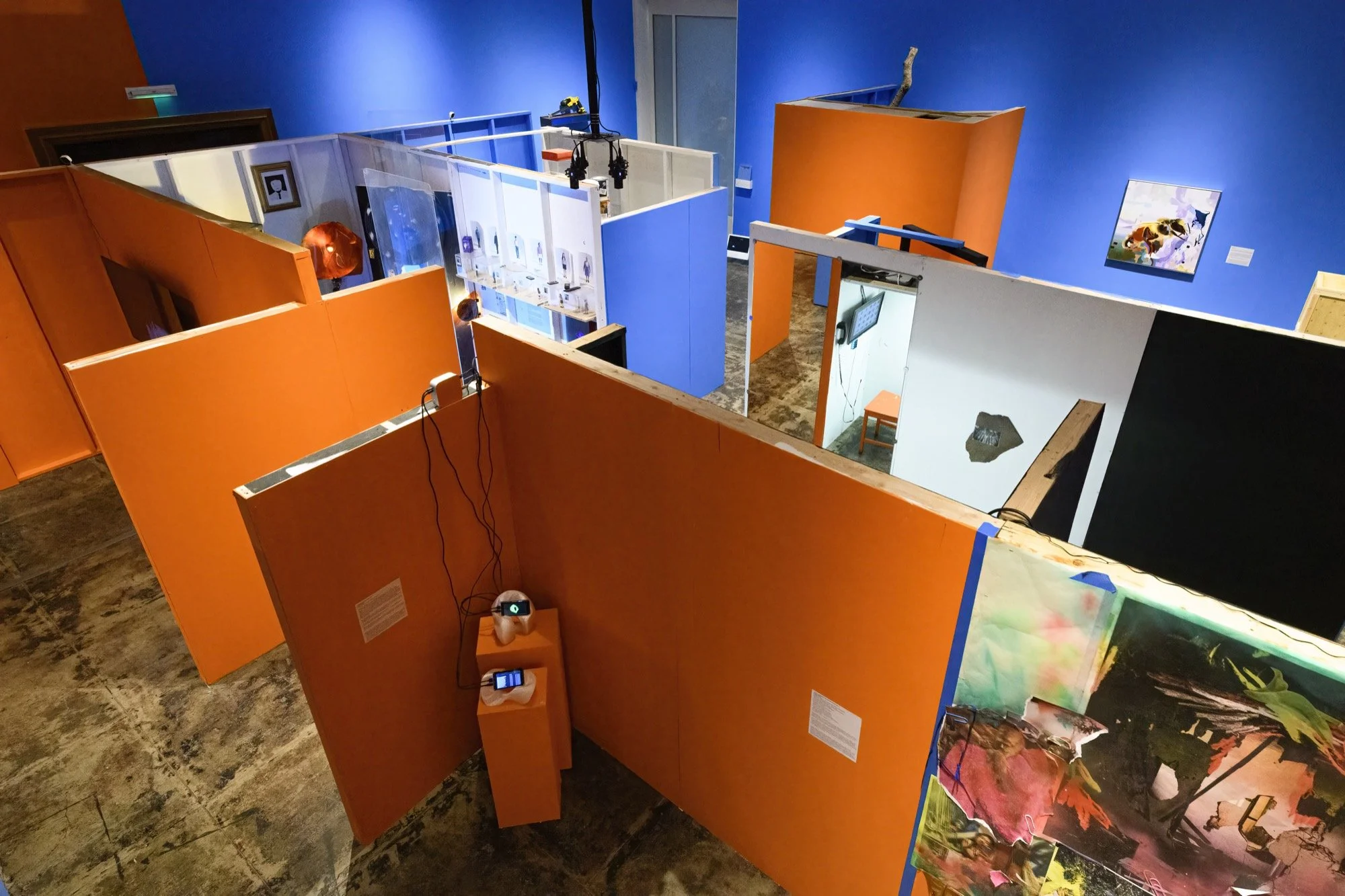
Installation view: EXTRA/PHENOMENALITIES at Stanford Art Gallery, 2026. Courtesy Stanford Art Gallery. Photo: Shaun Roberts.
EXTRA/PHENOMENALITIES
Stanford Art Gallery
Stanford, CA
January 22–March 13, 2026
The Art Critic Fellowship is an art writing intensive program launched in 2025. Now in its second year, fellows engaged in three lectures led by award-winning editors and writers to discuss the joys and concerns of writing and editing art criticism today, and met one-on-one with their assigned mentors to develop a piece of criticism for publication on AICA-USA’s Magazine.
The Art Critic Fellowship is supported in part by the National Endowment for the Arts.
Alex Feliciano Mejia is part of the 2026 cohort and was paired with Dorothy Santos as his mentor.
For me, Stanford University was a weird place to develop as an artist, especially having grown up about sixty-five miles north in Vallejo, a little city at the edge of the East Bay. Vallejo is pretty weird too, though: a working class city that experienced waves of deindustrialization, that was the vanguard of bankruptcy leading up to the 2008 recession, and that has lacked nonprofit arts infrastructure that its neighbors Berkeley, Oakland, and San Francisco have in droves. Still, Vallejo has a cultural footprint in the form of its many musicians and artists, a mark far larger than its size or location would suggest. Coming up as a skateboarder in the city, I borrowed my grandparents’ Mini-DV camera and started shooting verité footage in abandoned buildings, warehouses, and naval installations found throughout the city. Something was lurking in parts of the city left behind by industry and commerce. As a teen and young adult, I connected with friends through my employment at a local record store chain, who taught me to use samplers, turntables, and 8-track recorders to design sound and make music. Camaraderie and playfulness were the orders of the day as we made stuff with what we had around; a DIY ethic rooted in punk and hip hop guided and grounded us in our projects. Vallejo is a weird place – a place stripped of institutional resources, but full of people working with the stripped down infrastructure and using it as creative material. Constrained conditions, creative refusals.
Stanford is weird in a different way: a place full of resources, capital, infrastructure, full of people doing truly compelling work while also being deeply enmeshed in a university at the center of US capital accumulation and imperial statecraft. The Non/Phenomenal Collective’s recent exhibition at the Stanford Art Gallery, EXTRA/PHENOMENALITIES, sits right in that weirdness. The Non/Phenomenal collective’s founding members are Karin Denson, Shane Denson, and Brett Amory, the latter two being affiliated with Stanford University through employment and alumni status, respectively. The collective explores “how the conditions of perception and appearance are rapidly shifting in today’s technologically saturated world” through artistic, curatorial, and philosophical interventions. Before the Stanford show, they held two at Berkeley’s 120710 gallery, both questioning how AI, tech, and art related to those computational “operations immune to human perception.” The group’s philosophical bent stems in part from Amory’s time as a student in Shane Denson’s AI aesthetics course at Stanford.
EXTRA/PHENOMENALITIES features a range of artists, several affiliated with Stanford as employees or alumni, working across print, sculptural screens, video essays, and installations, all gathered under the banner of exploring what lies beyond appearances, beyond what we experience: the “extra phenomenal.” The curators ask viewers to consider what lurks behind the appearance of things we encounter in our everyday lives, including AI, technology more generally, but also in the natural world – and most definitely at the intersection of all of these material forces.
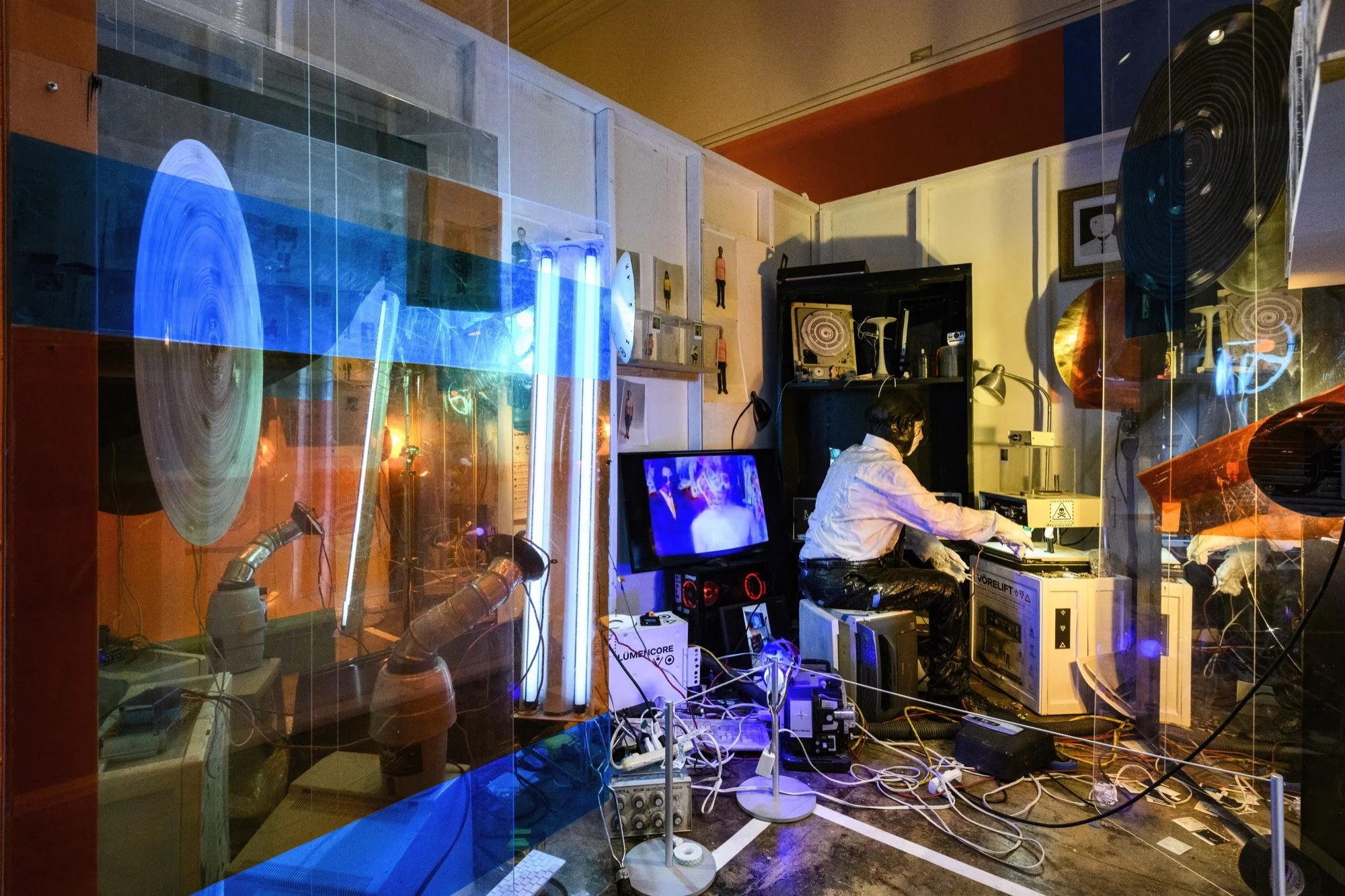
Brad Amory, Stand Clear of Active Light, 2025–26. Mixed media, dimensions variable. Courtesy the artist and Stanford Art Gallery. Photo: Shaun Roberts.
I walk through a maze of a gallery space, shaped by orange and blue plywood walls constructed into a labyrinth where every corner features some artist’s work on the walls or nestled in corners. I pass Stanford alumnus Miguel Novelo’s self-replicating virus sculpture: two phone-size screens nestled in 3d printed vessels of “non-euclidean shapes,” one displaying a list of viruses replicating every 10 seconds, and the other a non-euclidean shape moving through 3D space. Each offspring of the virus writes itself on the computer’s harddrive, taking up space and slowing down its host: a parasitic logic enacted on the very machine that displays the work. I turn a corner and encounter “No Evidence,” by Stanford Art Department Media Technologist, Frank Floyd: a tablet screen hangs from a branch, displaying tight close-ups of a face. The screen suspended as a surrogate body, the branch the rope: the arrangement unmistakingly evokes a lynching, and several of us viewers stop in our tracks. Brett Amory's Stand Clear of Active Light occupies a full room with a dense accumulation of obsolete and provisional technologies — broken screens, tangled wires, an 80s Macintosh, a misaligned animation camera, a Christmas tree color wheel slowly rotating — all of it wired together into an apparatus that feels both precarious and deliberate. At its center, Amory's familiar painted figure appears to regard itself, while a doppelgänger is projected behind it, visible to us but not to the figure. The installation makes its own infrastructure conspicuous: every cable, adapter, and borrowed fixture is exposed, refusing the sleekness of concealed technology.
These works, like so many others in the show, do exactly what the curatorial statement asks of viewers: consider that which is beyond immediate sensory perception, beyond the appearances. These works invite meditation on the infrastructural, the ideological, and the computational, each in their own way. Through these linkages, we can consider the sociopolitical “beyond” that shapes our encounters not only with technology and art, but with all facets of everyday life. This material conspicuousness is the show's greatest strength. These works expose the provisional, tangled, parasitic conditions under which technology operates. This is where Stanford's particular weirdness reasserts itself: the show's formal logic does the work of inviting us to experience the infrastructures that produce the necessary conditions for that which we experience. But the curatorial framing stops short of turning that logic on the institution that houses it. This is where things get a little murky: what does it mean to engage in conversations about AI, technology, and art practices on the campus of Stanford University, where key infrastructures of US imperialism have emerged and developed? I ask this as someone who not only studied there, but whose artistic formation was shaped by what the campus made available, by the generosity of faculty and graduate students doing work at the intersection of art and technology.
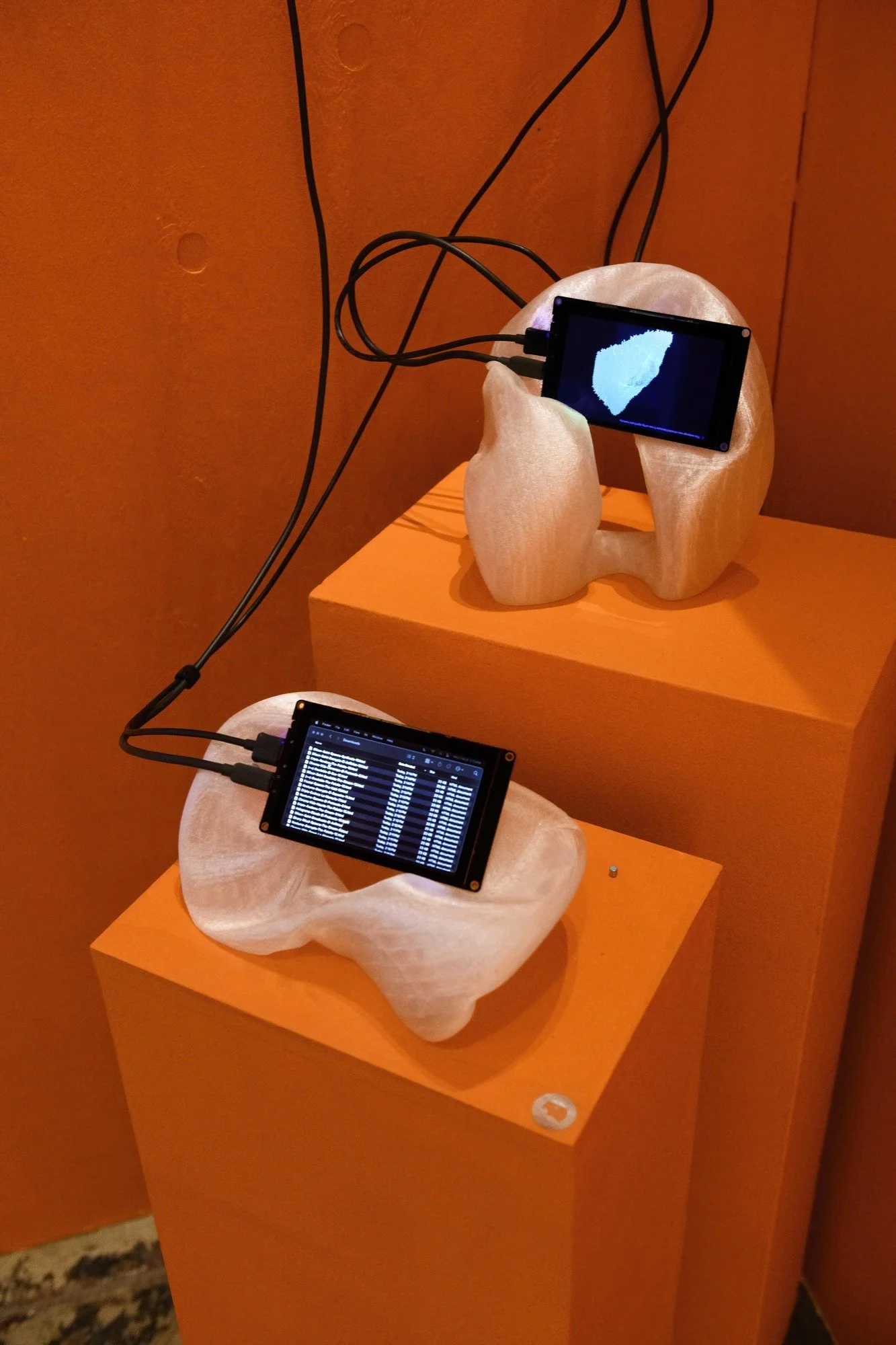
Miguel Novelo, NON-EUCLEDIAN virus, 2025. HTML, screen, computer, NFC, and 3D printing. Courtesy the artist and Stanford Art Gallery. Photo: Shaun Roberts.
We are 57 years away from when Stanford students and select faculty threw rocks, tear gas canisters, and metal pipes at computers in the Applied Electronics Laboratory, a branch of the “Stanford Research Institute,” with the goal of shutting down the institution due to its role in the imperialist war against Vietnam. We are about 15 days away from when the Iranian Islamic Revolutionary Guard declared US funded data centers legitimate targets due to the crucial role they play in generating material for US military and intelligence formations. We are 55 years away from when Stanford students and faculty broke into Stanford’s Computation Center and cut the power to computers that were running the “Gamut-H” program, responsible for generating strategic plans for the invasion of North Vietnam.[1] We are 3 months away from the trial of five Stanford students charged with felonies, charges pressed by Stanford University, for protesting the university’s complicity in the genocidal war in Gaza. From when, from when, from when.[2]
All of these protest movements happened at the heart of this bourgeois imperial university, and they constitute its history just as much as the “official” history of technological positivism does. Just as much as the awards, the grants, and the ongoing capital projects of building buildings and buildings do. Stanford wants to be known as a center for AI research, and their Institute for Human-Centered AI is a leading edge of this project.
But a cursory look at the institute’s publications reveal little that challenges AI’s role in the US imperial project, little that challenges the sycophantic premises underwriting the AI-imperial nexus. In fact, just weeks ago, HAI published a roundtable, "Who Decides How America Uses AI in War?"[3], in which several of its fellows argue that U.S. military use of AI is necessary to stay ahead of adversaries, and that AI companies expressing "qualms"[4] about Pentagon contracts are overstepping. The institute is actively producing the intellectual scaffolding that naturalizes the Pentagon as AI's legitimate client. The US imperialist political economy and its bourgeois ideological foundation is a core part of what constitutes that which is “beyond” our immediate phenomenological engagement with AI at this particular university.
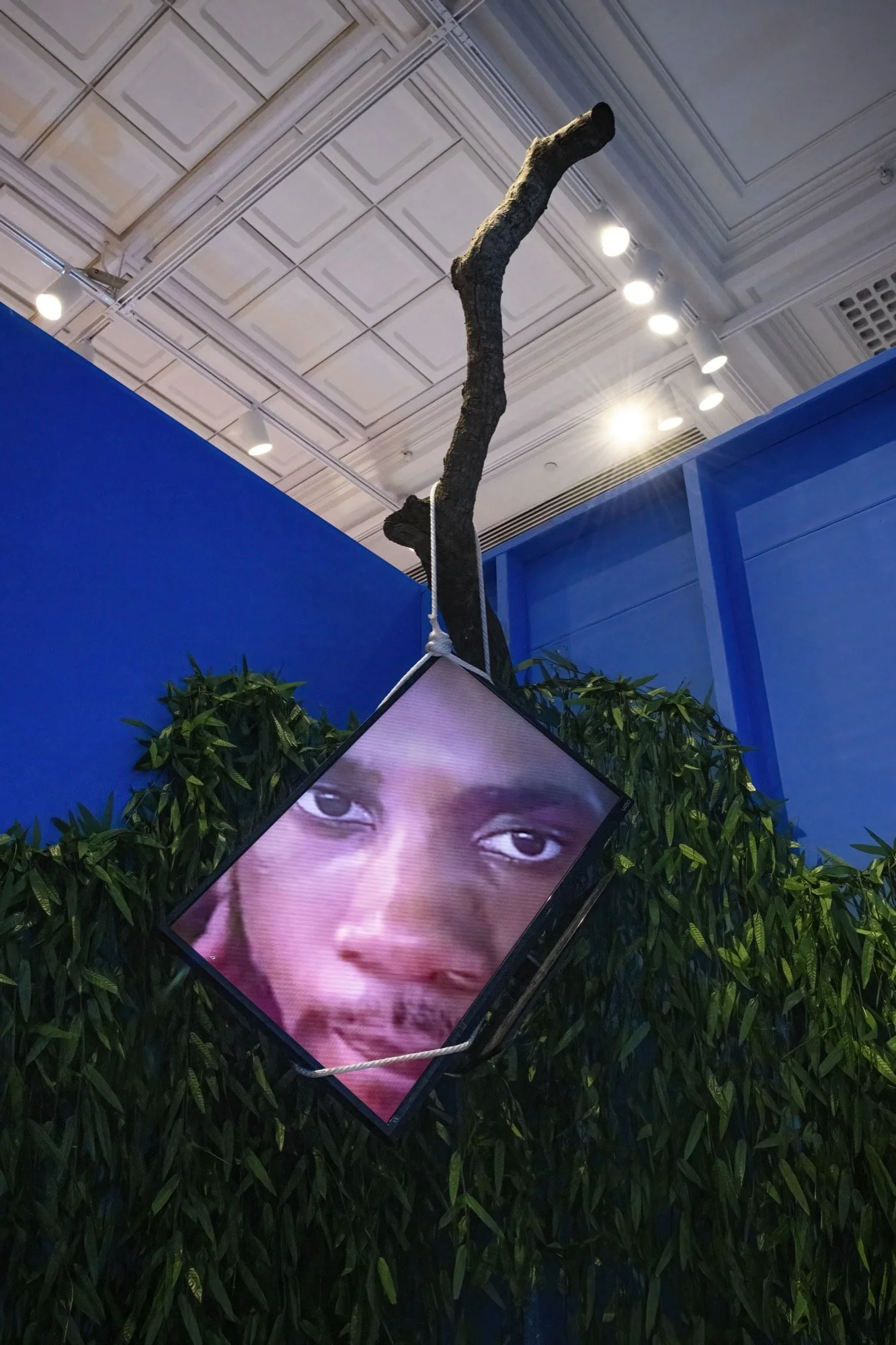
Frank Floyd, No Evidence, 2026. Single-channel surround-sound video installation; 11 minutes (looped). Rope, 32” monitor, locally-sourced tree limb, three speakers, foliage. Courtesy the artist and Stanford Art Gallery. Photo: Shaun Roberts.
We are now in the middle of a political moment where the future of US imperialism is forcing itself into our everyday lives in the form of rising energy prices, food prices, and, yes, the threat of “our” datacenters and capitalist firms of technology being subject to attack by “our” adversaries. And yet, for many of us living in the imperial center of the United States, it’s all too easy to background these sociopolitical dynamics and carry on with our work, our research, our art practices. The EXTRA/PHENOMENALITIES show’s curatorial focus on that which is beyond our everyday appearances may not be framed as an anti-imperial intervention – in fact, it’s certainly not – but its phenomenological focus opens up spaces to question the conditions that give rise to everyday life in this dystopian timeline. There’s an opportunity to make curatorial, artistic, and philosophical interventions that ground us in the place that we create in – to center the cities and universities that we inhabit in a reflexive way.
Wherever we find ourselves, there are crucial sociopolitical and economic engines behind the appearances of those entities we call “Vallejo” or “The Bay Area” or “Stanford.” In Vallejo, the constraint was the absence of institutional resources, and the creative response was people making things with whatever was around. At Stanford, the constraint is the opposite: an abundance of resources conditioned by the very imperial exigencies that determine what can be said about them. To question the imperio-techno-bourgeois materialities that condition the possibility of our shows, practices, and collectives. The extent to which curatorial discourses around AI, technology, and aesthetics confront imperial political economies and their university partners remains to be seen, but the EXTRA/PHENOMENALTIES show opens up a phenomenological angle with which to get there.
[1]. https://caselaw.findlaw.com/court/ca-court-of-appeal/1842196.html
[2]. For more on the anti-imperialist war movement at Stanford, see the Stanford Historical Society Collections on the “Movement Project: Anti-Vietnam War and Allied Activism at Stanford, 1963-1973,” and the San Francisco State University’s Bay Area Television Archive collection of unedited new footage on several protests at Stanford: https://exhibits.stanford.edu/shs/feature/movement-project-anti-vietnam-war-and-allied-activism-at-stanford-1963-1973; https://diva.sfsu.edu/collections/sfbatv/bundles/189803
[3]. https://hai.stanford.edu/news/who-decides-how-america-uses-ai-in-war
[4]. https://www.thefreedomfrequency.org/p/you-should-have-moral-qualms-about
Alex Feliciano Mejía is a writer, filmmaker, and educator whose practice centers on the relationship between archives, displacement, and cultural memory. His current projects involve working with 16mm film archives in Guatemala and collaborating with Central American diasporic communities in the Bay Area through participatory and essayistic filmmaking. He teaches courses on media arts pedagogy and multilingual pedagogy at San Francisco State University, where he’s also an MFA candidate in Creative Nonfiction (writing/filmmaking).