
Public Relations
Félix González-Torres in Milwaukee
Luke Urbain | April 17th, 2026
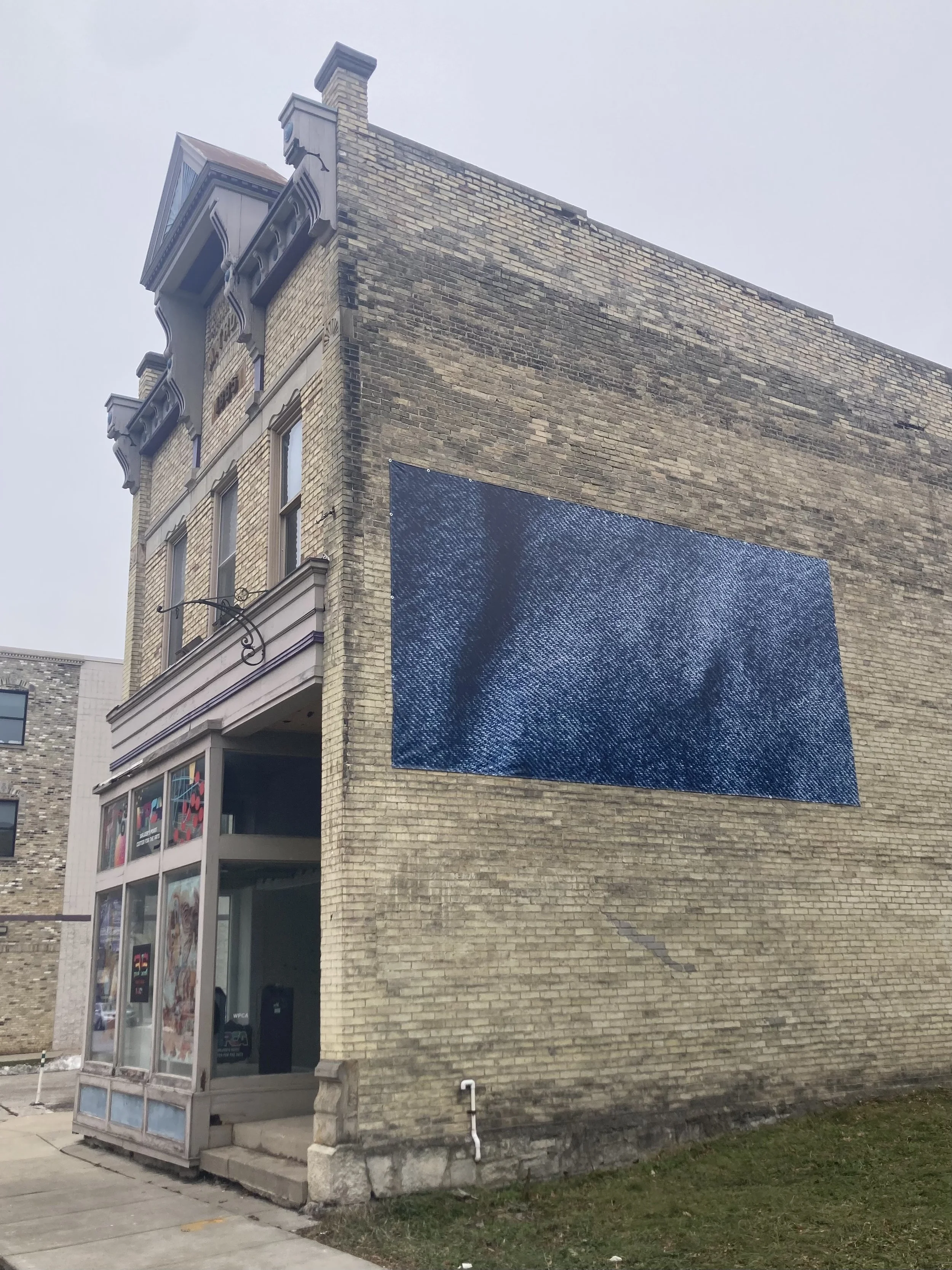
Installation view: Felix Gonzalez-Torres, "Untitled" (The New Plan), 1991 at Walker's Point Center for the Arts, Milwaukee, WI. Photo: Luke Urbain.
The Art Critic Fellowship is an art writing intensive program launched in 2025. Now in its second year, fellows engaged in three lectures led by award-winning editors and writers to discuss the joys and concerns of writing and editing art criticism today, and met one-on-one with their assigned mentors to develop a piece of criticism for publication on AICA-USA’s Magazine.
The Art Critic Fellowship is supported in part by the National Endowment for the Arts.

Luke Urbain is part of the 2026 cohort and was paired with Brandon Zech as their mentor.
Nestled blocks away from Milwaukee’s more conspicuous Mural of Peace, a relic of 1990s multiculturalism that favors stark blocks of color, resides a decidedly more opaque work of public art. On South Fifth Street in what is often considered the city’s oldest neighborhood, the vinyl skin of one of Felix Gonzalez-Torres’s “billboards”is hung midway up the amber brick wall of Walker’s Point Center for the Arts’ two-story building. As I approached “Untitled” (The New Plan) (1991) last December, it took on different forms—an indigo monochrome, an aerial view of the sea, and, finally, a sheet of denim—a shapeshifting that itself hints at the formal and ideological malleability inherent in the artist’s work.
Although from what I can tell Gonzalez-Torres visited Milwaukee only once in 1993, last year the city became the latest canvas in the evolving, posthumous display of his billboards. [1] The series secretes enigmatic and intimate scenes—a bird in flight, an open hand, an empty bed—into advertising’s lexicon, where monumental scale renders the images at once conspicuously present and strangely out of place. Wherever they were to be located, the artist stipulated there be between six and twenty-four billboards installed simultaneously at different locations to reach “a broad cross-section of the general public.” [2] Accordingly, the Walker’s Point billboard was just one of nine manifestations of “Untitled” (The New Plan) dispersed across southeastern Wisconsin last year—the side of an art museum on University Hill, an avenue downtown, a road in New London, and so on. [3] Fleeting yet recurrent, even if you speed past a few times, repeated encounters accumulated across months allow for a more subtle spectatorship to unfold, one that hums along at a lower frequency than the museum’s call to regard in a singular way.
It’s hard to discern what type of engagement is desired or even merited by a work so discrete as to verge on ambient. The source photo’s exclusive focus on denim invites us to trace some of the social and material histories embedded in their subject. As Imani Perry writes, “Denim was sturdy and durable, and it was dyed with indigo because of how colorfast—or how true—the dye was. It kept its appearance through the roughness of labor.” [4] By the 1960s, denim became a consciously political sign used both by members of the Student Nonviolent Coordinating Committee and the Chicano Movement to signal solidarity with sharecroppers and agricultural laborers. Then in the 1970s, jeans were reimagined by gay men of Gonzalez-Torres’s generation as part of a uniform, a knowing appropriation of blue collar aesthetics tied to the imaginary of western masculinity—cowboys, farmers, lumberjacks. Levi’s 501, writes Steven Stines, had “the advantage of a button-fly that not only visually enlarged the crotch but also offered the opportunity to neglect closing all five buttons.” [5] If you’re able to look beyond denim’s ubiquity, these threads index protest and desire, gloss dissimilar histories of racialized labor, political movements, and modes of queer address; yet they also open Gonzalez-Torres’s work as a scene where the intimacies within and across these histories might become legible.
Some of these histories come into sharper focus at particular sites. The Walker’s Point Center for the Arts, a place where I volunteered during my high school and college years, is a five-minute walk from an enclave of the city’s remaining queer bars; it is also the area of Wisconsin where Spanish is most often spoken. This is to say that this particular billboard exists quite literally at the cross section of the city’s queer and Latinx communities, which in turn activates a certain bandwidth of the artist’s own life as a gay man born in Cuba who lived and worked in the United States. It’s a place where these different communities meet not through the aspirational banner of multiculturalism, but through ordinary and unpredictable exchanges that accumulate as the texture of social life.
Returning to the billboard, “Untitled” (The New Plan) is imbued with a delicate and sparkly eros. Since the focus on denim alone is so total that it forecloses any other detail, it’s unclear whether the jeans (if that is what we are looking at) are being actively worn or cast aside, whether a body that fills them presses outward or whether they’re hastily thrown across the floor. Moreover, given the mortuary time in which Gonzalez-Torres worked it’s also uncertain whether the jeans might serve as a memory of someone who once wore them. The photograph’s propinquity implies closeness, which in turn posits a hypothetical intimacy. If you’re this close to someone, it’s likely in an embrace, lazing in a puddle of bodies, or perhaps the precise moment before the jeans come off.
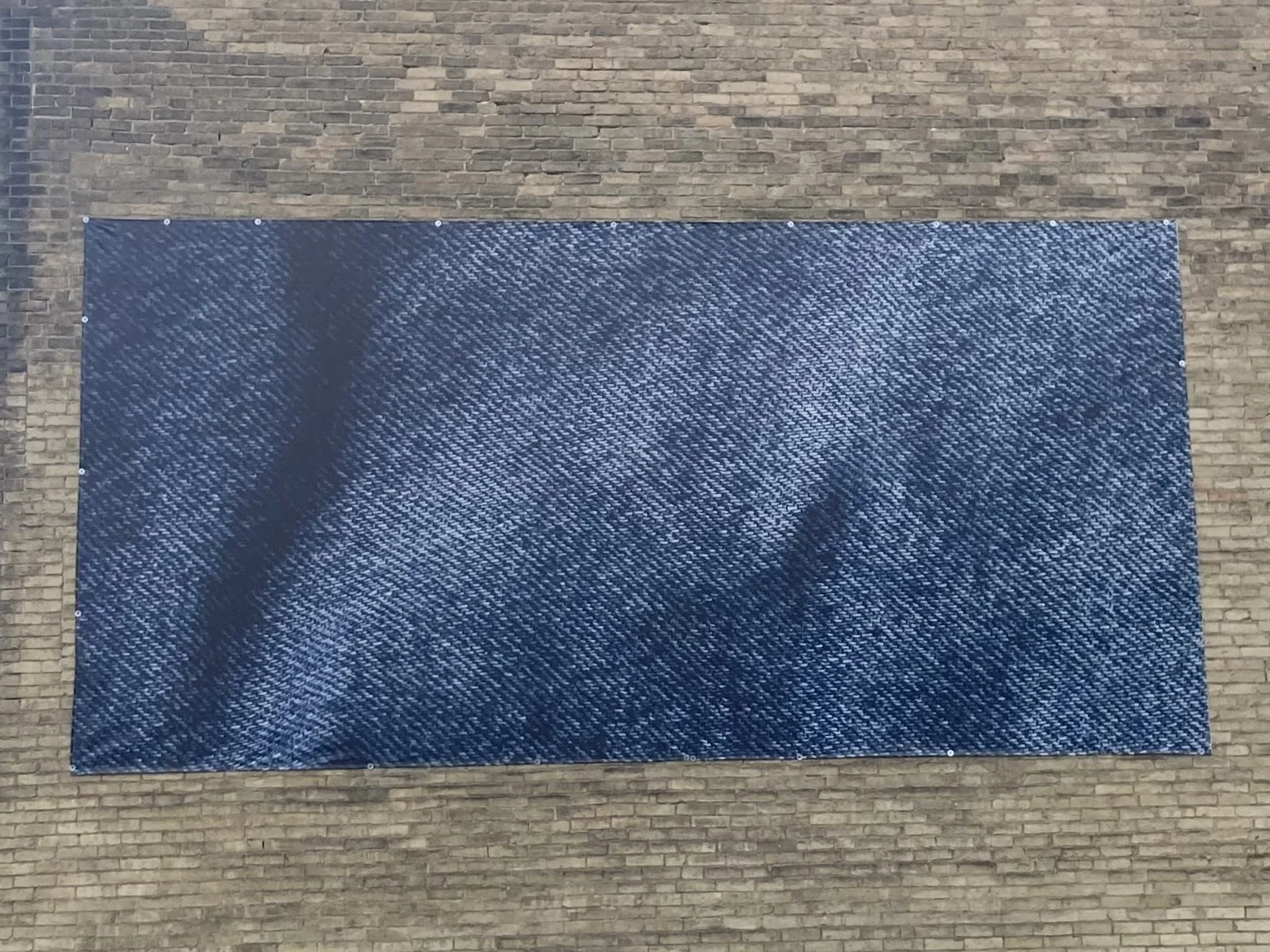
Installation view: Felix Gonzalez-Torres, "Untitled" (The New Plan), 1991 at Walker's Point Center for the Arts, Milwaukee, WI. Photo: Luke Urbain.
“At this point in history, how can we talk about private events?” [6] The billboard works, Gonzalez-Torres tells us, emerge from the politics of their day, the late 1980s, when, just to start, queer peoples’ consensual private actions were circumscribed by the Supreme Court and representation of certain bodies begot congressional proceedings that threatened to slash federal funding for the arts altogether. Given these constraints, the billboards sidestep scandal by halting the representation of a specific body or kind of body. In this way, they traverse both private and public simultaneously, situating anodyne scenes of hypothetical intimacy within an expanded, if decidedly more ambivalent, matrix of social relations.
I would like to activate the filaments of these works with my words, to make them durable, non-contingent, essential; but whatever interpretation I assign slips away. If you want to see a possible scene of precarious life rendered liveable, it’s available for that. If you want to see a fabric as bland as white bread, there’s that, too. And you could pass by it altogether. Herein lies the frustration: “Blank spaces that simultaneously proffer and defer a promise of meaning,” art critic Jans Avgikos observed, “ are central to Gonzalez-Torres’ work.” [7]
In recent years, these blank spaces have bloated, and exhibitions of Gonzalez-Torres’s work have appeared motivated by a computational logic, a drive to exhaust every permutation allowed by the artist’s written instructions at the expense of its vitality. This includes a loose attempt to bring his work into the influencer age; an anonymous-feeling showto mark his posthumous move to David Zwirner; and the decision to elide mention of AIDSin key works by two major museums. An attack by omission, this approach comes off as out of step with an artist whose work signalled Palestinian solidarity, likened theSupreme Court’s conservative majorityto a regime of racial terror,tallied the 460 people killed by gunsacross one week in the United States, and, even in his more enigmatic later period, spoke to longing and loss in the crosscurrents of migration and AIDS. To Gonzalez-Torres’s many acolytes, myself included, engaging the artist’s work in earnest has become an embattled project.
But we have his words, urgent and pulsing statements that coalesced disparate statistics to limn a country where spending on the military outstripped housing, social and healthcare programs were being defunded, an expanding information industry threatened appeals to common sense, and incarceration and child poverty rates soared, all while a conservative slight-of-hand rendered these concerns trivial through culture wars and actual wars. Three decades after the artist’s death of complications from AIDS, the resonances abound.
“How is one supposed to keep any hope alive, the romantic impetus of wishing for a better place for as many people as possible, the desire for justice, the desire for meaning, and history?” [8] The artist’s words operate against the opacification of his work. They accrue meaning by specifying and accumulating context as opposed to foreclosing it. I imagine the building on which “Untitled” (The New Plan) is displayed in Walker’s Point does something similar. It’s made of cream city brick, a lacustrine clay threaded along Lake Michigan’s western shore that’s endemic to the city’s architecture. Porous and thirsty, it absorbs particulate matter in the air, soaks up context indiscriminately, deepens in color, and wears its environment as a visible sign of time’s accumulation.
Look around, the billboard urges, and, in doing so, it returns you to the world. I am here in Walker’s Point with the person I love on a late December day, I should note. I’m old enough for someone to have written “Don’t get AIDS” in my high school yearbook but not young enough to have thought reporting the line would be a good idea. I’m old enough to have left the first stable job of my life because my employer wouldn’t use my pronouns. My husband has his own stories, but they are his to tell. Multiple recessions in, we are trying to make a life amidst the tangles of chords and all the violence, trying to remain sensitive to a world that holds so much from which to turn away.
Any effort to grasp Gonzalez-Torres's work requires that we bring our own erratic reading habits and wobbly personal histories to it in potentially unseemly ways. Stand in an empty lot in Walker’s Point or drive down a road in New London. Gonzalez-Torres engages these scenes without witnessing them; he inhabits them without fixing them. He lets them remain what they are, a loose coalition that can attain a provisional unity if held up to the light in just the right way.
[1] The artist visited Milwaukee for the exhibition Currents 22: Felix Gonzalez-Torres at the Milwaukee Art Museum, which ran May 28 to September 12, 1993 and included a different billboard work. More recently, billboard works have been shown, among other places, in a more comprehensive project in Texas in 2010 and an exhibition of the same work in a Paris exhibition in 2022.
[2] “Core Tenets for Gonzalez-Torres’s billboard works Draft,” Felix Gonzalez-Torres Foundation. February 9, 2026, https://www.felixgonzalez-torresfoundation.org/attachment/en/5b844b306aa72cea5f8b4567/DownloadableItem/681cf5e5ffc65450e006d19d.
[3] The display is a collaboration between Sculpture Milwaukee and The Felix Gonzalez-Torres Foundation.
[4] Imani Perry, Black and Blues: How a Color Tells the Story of My People, Ecco, 2025, 37.
[5] Steven Stines, “Cloning Fashion: Uniform gay images in gay apparel,” Critical Studies in Men’s Fashion 4, no. 2 (September 2017): 136, https://doi.org/10.1386/csmf.4.2.129_1
[6] Joseph Kosuth and Felix Gonzalez-Torres. “Joseph Kosuth and Felix Gonzalez-Torres: A Conversation,” A. Reinhardt, J. Kosuth, F. Gonzalez-Torres Symptoms of Interference, Conditions of Possibility. Art & Design Magazine , 1994, 81.
[7] Jan Avgikos. “This Is My Body: Felix Gonzalez-Torres,” Artforum International, 1991, 81.
[8] Felix Gonzalez-Torres, “1990: L.A., ‘The Gold Field,’” In Earths Grow Thick. Wexner Center for the Arts, 1996, 150.
Luke Urbain is a scholar and writer who works on aesthetic responses to social and economic precarity in the Caribbean and its diasporas, with particular attention to the folds of race, queerness, and coloniality. Their criticism asks what aesthetics can offer to the elaboration of alternative political forms and modes of care. Their writing has appeared in the US Latinx Art Forum as part of the Latinx Unsettling collection from the series “X as Intersection: Writing on Latinx Art” as well as Cuban Studies and Latin American and Latinx Visual Culture.