
Analog Ghosts on the West Coast
Caitlin Chavez | April 17th, 2026
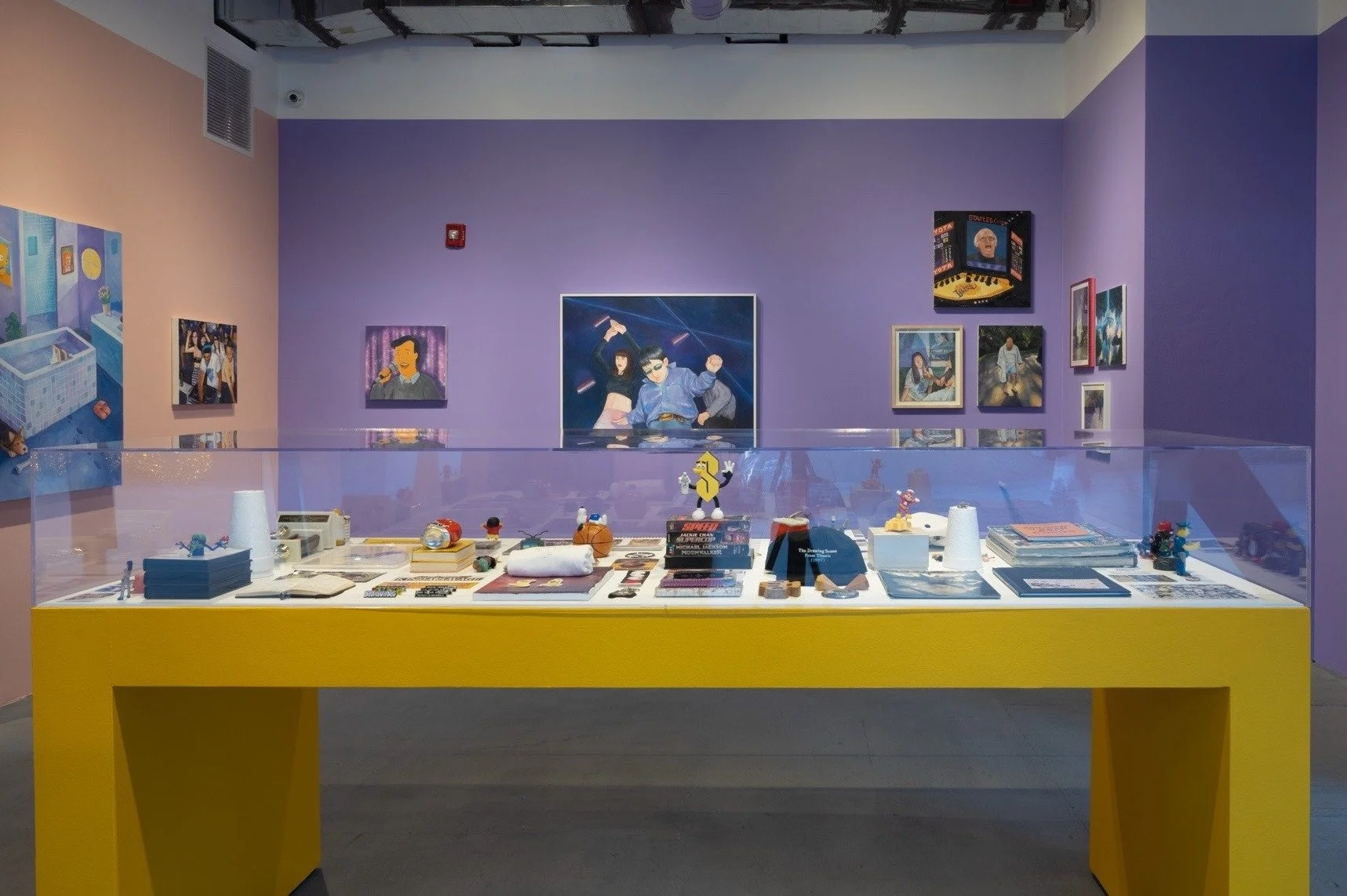
Installation view: Kristofferson San Pablo, For All The Ghosts, UCR Arts. Riverside, CA, 2025–2026. Pictured: Atlas 3000 (After Richter). 2025. Various items & ephemera in painted vitrine. Courtesy the artist and UCR Arts.
Kristofferson San Pablo
For All The Ghosts
Culver Center of the Arts
UC Riverside
November 23, 2025–April 12, 2026
The Art Critic Fellowship is an art writing intensive program launched in 2025. Now in its second year, fellows engaged in three lectures led by award-winning editors and writers to discuss the joys and concerns of writing and editing art criticism today, and met one-on-one with their assigned mentors to develop a piece of criticism for publication on AICA-USA’s Magazine.
The Art Critic Fellowship is supported in part by the National Endowment for the Arts.
Caitlin Chavez is part of the 2026 cohort and was paired with Courtney McClellan as her mentor.
Pressed up against the glass outside of the Culver Center of the Arts (CCA), Gen-Zers in downtown Riverside mimicked the gaggle of Garfields suction-cupped to the interior of the window for a snapshot. Even though the orange Monday-phobic cat became known through his decades-long run in newspapers and TV specials beloved by earlier generations, Garfield continues to attract younger generations through new film releases (lasagna sponsored by America’s most popular Italian restaurant chain) and the scroll of memes.
Kristofferson San Pablo’s More Lasagna than Can Ever Be Repaid (After Mike Kelley), an homage to both Garfield and artist Mike Kelley, is a preview of the collocation of the popular and the personal perceptible throughout the artist’s solo exhibition For All the Ghosts. Drawings and paintings of West Coast interiors, screenshots from social media, and portraits of San Pablo’s family and friends weave in stylistic variations of classic cartoon favorites like Snoopy and The Simpsons, as well as other pop culture figures culled from television, film, mainstream music, and sports.
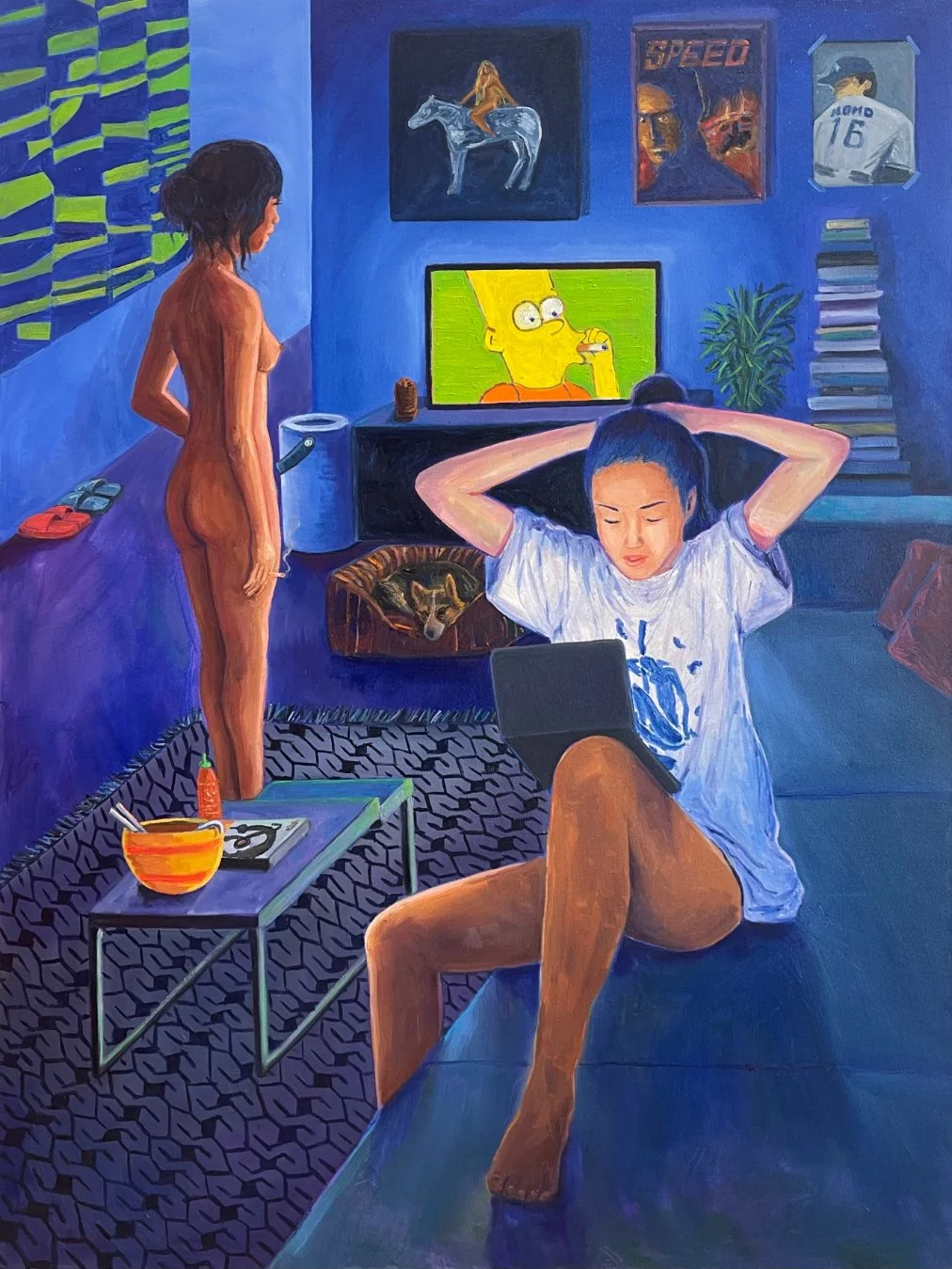
Kristofferson San Pablo, Plastic Off The Sofa, 2023. Oil on canvas. Courtesy the artist and UCR Arts.
Two vitrines,Atlas (After Richter) #1 and #2,encase photos of family members and friends, VHS tapes of breakdancing and films from the 1980s through early 2000s, cassette mixtapes, magazines, and memorabilia, appearing alongside zines, drawings, commercial work, and projects from San Pablo’s graphic design imprintVacancy Projects. The physical media, handled with a white-glove museum treatment, is neatly stacked in piles and organized in a balanced grid, allowing maximum exposure of titles for viewers to read and potentially trigger a trip down the proverbial memory lane.
When I saw Michael Jackson’s Moonwalker VHS tape in the glass case, “Man in the Mirror” began playing in my head. I stifled a laugh, remembering singing (ruining) the song at home alongside my husband. Scanning the vitrine, I spotted a pen illustration of a jersey-ed golden retriever guiding a basketball into a slam dunk. Quotes from Air Bud echo in my ears as the favorite tape my brothers had on repeat during childhood summer vacation 1998, stuck at home in Southeast Texas suburban sprawl.
Like my personal recollections of this media, San Pablo positions pop culture icons alongside his loved ones in memory-making. The title of the work cites Gerhard Richter’s installations with panelled glass, similarly providing a filter of the viewer’s reflection while peeping at San Pablo’s arrangements. These are not just items the artist has collected; they are repositories for manifold moments of memory– a glance at the Rush Hour 2 VHS, the Proustian madeleine which triggers remembrances of family and friend gatherings of the past, watching the movie for the umpteenth time, and quoting Jackie Chan and Chris Tucker’s lines.
The frequency of popular media in illustrations and paintings, especially cartoon characters, brings to mind childhood drawing as a type of social currency—perhaps one that a young, first-generation Filipino immigrant who moved to Southern California at 12 years old used as an entry into connecting with his new community in Fontana, alongside utterances of memorable lines from popular films or imitating the moves of famous breakdancer Steffan “Mr. Wiggles” Clemente at gatherings—a scene featured in one of the artist’s childhood photos in the vitrine.
In anessay written by the exhibition curator Nickolay Maslov, San Pablo’s Fontana upbringing reflects an idea shared by another Fontana-ite, Mike Davis, who proposes the city as “the junkyard of dreams” containing invisible blueprints for its subsequent industrial development in his book City of Quartz. Fontana, about a one-hour drive from Los Angeles and the coast, has nearly quadrupled in population since the 1980s, driven by the explosion of the logistics and trucking industry that developed this area throughout the 90s and early aughts. For San Pablo, he is unable to return home to the Fontana of his childhood—only the ghosts of the homes and haunts he frequented in his youth remain, while the landscape bears the fruits of decades of urban planning.
While these tinges of nostalgia for the Fontana of his formative childhood years provide theoretical grounding for the juxtaposition of images excavated from both memory and commercial culture, influences from art history and San Pablo’s fine arts education are woven throughout the exhibition. Earning his MFA from the ArtCenter College of Design in Pasadena, San Pablo learned under the tutelage of artists like Mike Kelley, putting him in company with a range of commercial and industrial design programs and filmmakers, as well as a rigorous program that included graduate seminars with art historians.
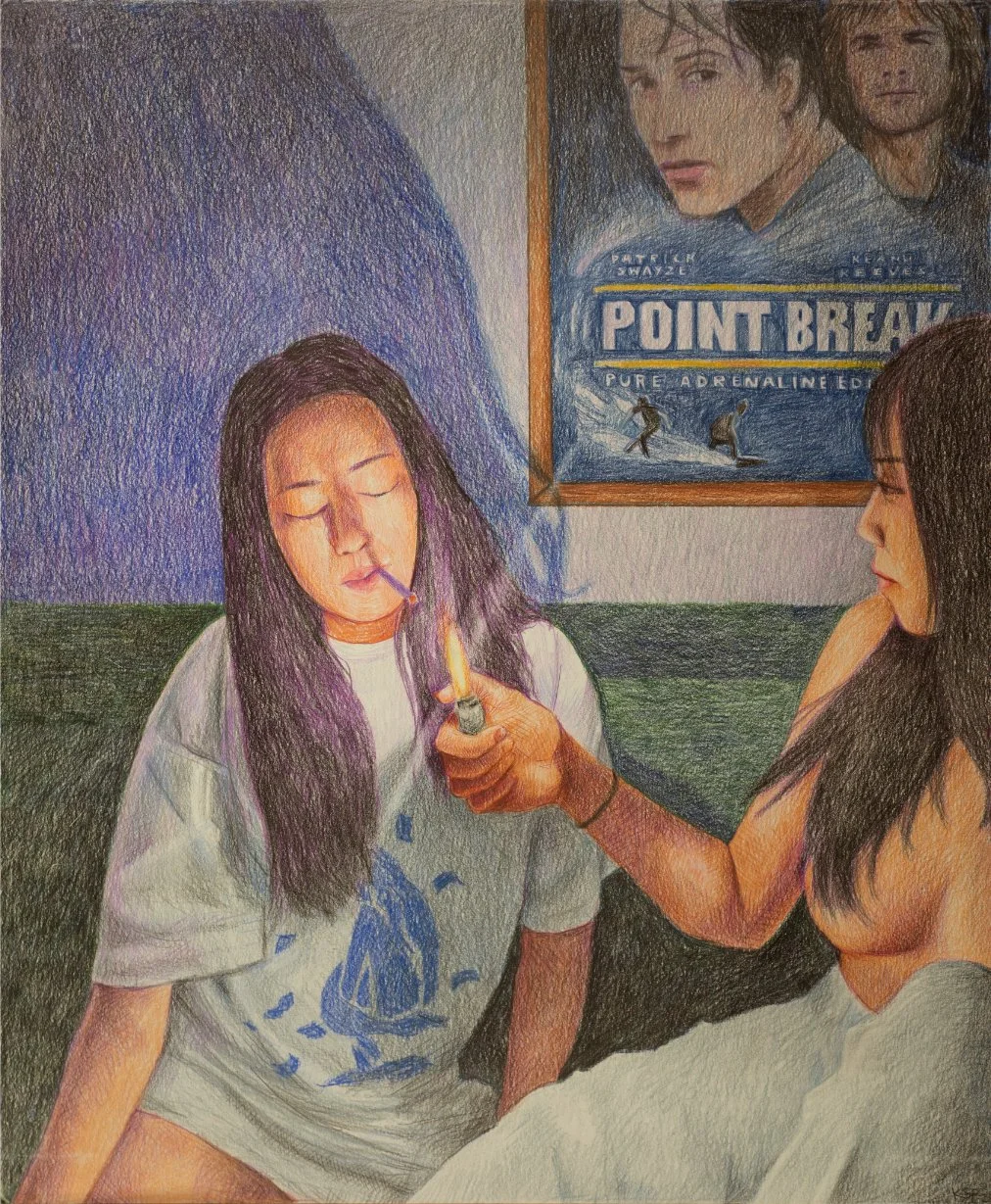
Kristofferson San Pablo, Friday Night Lights, 2024. Colored pencil on paper. Courtesy the artist and UCR Arts.
Art history, alongside popular media, San Pablo frequently mines for imagery in his drawings and paintings.Friday Night Lights casts two women in a contemporary California genre scene—sitting on a couch, sparking up a joint. The lighter illuminates the face of one figure like the Baroque light of George de la Tour. Throughout the exhibition, Friday Night Lights (2024) and several other rendered works in colored pencil employ a Pointillist technique à la Georges Seurat, creating a fuzzy effect that mirrors the image quality of CRT televisions prior to the transition to Plasma and LCD TVs at the turn of the twenty-first century.
Napoleon Crossing the Caldwell plucks inspiration from this early 2000s era of television, freezing Tony Soprano in a scene from the HBO show that both mimics the equestrian portrait of figures like Napoleon and captures the Surrealist influences from ‘The Test Dream’ episode (2004). San Pablo’s work is also in dialogue with contemporary artists frequently billed in international blockbuster exhibitions, including David Hockney and Marina Abramović. Stark Hockney-esque interiors tuck a tubular corgi (one of a couple owned by the artist) with elongated nudes in LA apartments decorated with pop culture ephemera inLight Through an Open DoorandPlastic off the Sofa. In the former, the scene is cast in a dusky orange light from closed blinds, in opposition to the brilliant blues captured in Hockney’s Los Angeles paintings. Two figures, one stark naked and the other in panties, with the light from her cell phone illuminating her face, are potentially deciding on evening plans, while the eyes of one of San Pablo’s corgis peeks behind the bed. A Point Break movie poster, Rihanna’s iconic pink pixie cut at the 2014 LA Clippers game, and a Lakers pennant are tucked in a corner adjacent to a wall with a Mark Rothko-esque panel.
Plastic Off the Sofa squeezes in more art-historical references through San Pablo’s favorite imagery in a tight domestic scene. A nude with her back to the viewer watches Bart Simpson take a drag of a cigarette, while another lounging woman in a Henri Matisse “cut-outs” shirt leans back, her face illuminated by a tablet resting on her knee. Beyoncé, Keanu Reeves in Speed, and Los Angeles Dodgers pitcher Hideo Nomo decorate the back wall adjacent to a sleeping corgi and “that ‘S’ shape patterns a rug.
The echo of Marina Abromavić’s eminent performance piece appears in multiple forms. I first encountered it in a Vacancy Projects zine in the vitrine, shortly followed by a short film clip–both casting Pam from The Office in the role of Abromavić. On March 5th, San Pablo staged a performance of Drawing Restraint 3000 parodying The Artist is Present against a backdrop of high-energy, nostalgic dance music. In the central foyer of CCA, he invited participants to throw flip-flops at him while he drew a quick portrait of the sitter. A familiar face seen throughout the exhibition—rendered in paintings, drawings, and photographs with the tenderness of looking upon one’s beloved— the artist’s wife appears in the performance armed with a dozen flip flops. She laughs at and with San Pablo, who is trying to draw while dodging (and getting walloped) by the sandals she pelts at him. The colorful sandals, sourced from a sculpture called After Party at the End of the World are placed at the entrance of the gallery, as if to invite viewers to take their shoes off before entering the space and to make themselves at home in the exhibition.
Throughout the exhibition, viewers are invited to slow down. Not just to explore all of the visionary delights packed into San Pablo’s figurative works, but also to reflect on our own memories and how they are not only forged into our unconscious by specific cultural moments,like the cartoons and movies we watch and the music we listen to, but also carried with us into the present and future. We appear in San Pablo’s vitrines, not just because of the reflective nature of the material, but also how accumulations of material from our own childhood might serve as touchstones of memory in our own lives. For All the Ghosts reveals how the objects and references we surround ourselves with serve as anchors for the present, so that we can hold on to memorialize our moments with loved ones as the places we know are changing beneath us.
Caitlin Chavez is a writer, educator, and non-profit consultant working in Southern California and the Texas Gulf Coast. In her art writing practice, she strives to spotlight underrepresented artists and institutional critique. Chavez currently serves as Full Time instructor of Art History at Imperial Valley College, adjunct instructor of Art Appreciation at Cuyamaca College, and Grant and Development Lead at the Imperial Valley Food Bank. She holds an MA in Art History from the University of Houston and an MA in Modern French Studies from the University of Kent, Canterbury, UK and Paris, FR. Her writing has appeared in Glasstire, Southwest Contemporary, and regional publications in California and Texas.